Collaborative Robots
What a Cobot Costs in Its First Year
The arm is a quarter of the bill. A line-by-line first-year cost model for a collaborative robot cell, including the items that surprise buyers after the quotation is signed.
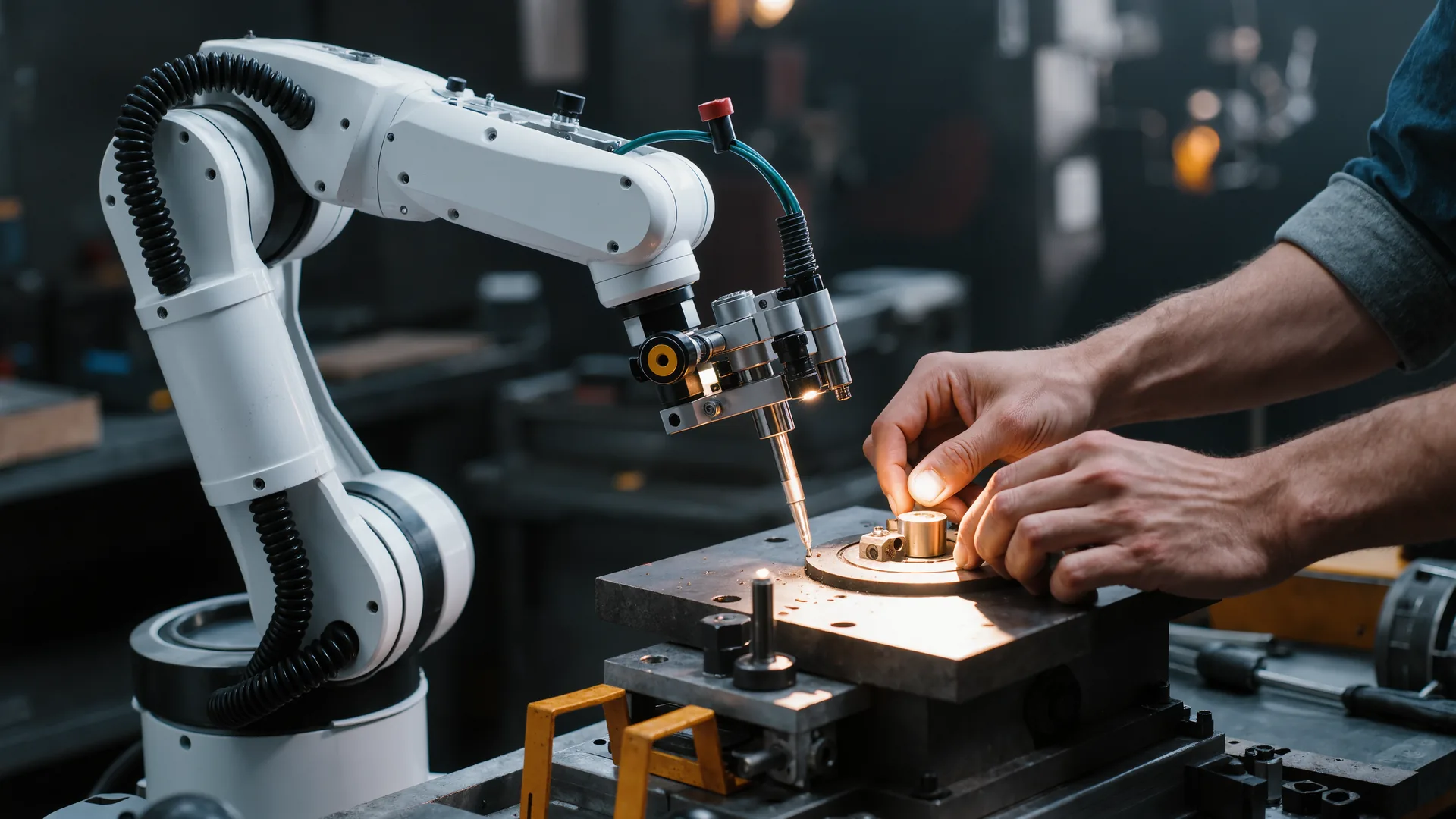
Budget 2.5 to 4 times the arm price for the first year. A collaborative arm in the 5 kg to 10 kg class typically lists between 20,000 and 45,000 euro depending on class and region, and a working cell around it lands between 55,000 and 160,000 euro once tooling, fixturing, integration, validation and the first year of running costs are counted.
The line items nobody skips
Prices below are indicative ranges for a single-station cell in Western Europe or North America, at 2026 levels. They are meant for a sanity check on a quotation, not as a substitute for one. Regional labour rates move the integration line more than anything else.
| Item | Low | High | What drives it |
|---|---|---|---|
| Collaborative arm, 5 to 10 kg class | 20,000 | 45,000 | Payload class, reach, brand |
| End effector and coupler | 2,500 | 14,000 | Vacuum versus servo gripper, tool changer |
| Vision or force sensing | 0 | 22,000 | 2D versus 3D, bin picking software licence |
| Fixturing, nests, part presentation | 4,000 | 25,000 | Part variety and tolerance |
| Base, pedestal or mobile trolley | 1,200 | 9,000 | Fixed pedestal versus lift column |
| Safety hardware not eliminated | 800 | 12,000 | Scanners, mats, light curtains, guard plates |
| Integration engineering | 12,000 | 48,000 | Interfaces to machine, PLC, MES |
| Risk assessment and CE file | 2,500 | 9,000 | Number of contact scenarios |
| Validation measurement | 1,500 | 6,000 | Reachable contact points |
| Training, 2 to 5 people | 1,500 | 6,000 | On-site versus vendor academy |
| Spares and first-year service | 1,500 | 7,000 | Coverage level, response time |
| First-year total | 47,500 | 203,000 | Typical projects land at 55,000 to 160,000 |
The four lines that surprise buyers
Quotations are usually honest about the arm and vague about everything downstream. These are the items that appear after the purchase order.
- Part presentation. A robot that cannot find the part reliably is not a robot problem. Trays, nests, escapements and infeed conveyors regularly cost more than the gripper, and on high-variety work they can exceed the arm.
- Validation measurement. Contact-permitted operation requires measured force and pressure at every reachable contact point with a calibrated instrument. A cell with a dozen reachable points is a full day, and it must be repeated after any change to speed, payload or tooling.
- The interface to the machine. Opening a CNC door, confirming chuck state and handshaking with the control is a controls project. On older machines without a robot interface this line alone can run from 4,000 to 20,000 euro.
- Safety hardware that survives. Very few collaborative cells end up with no safety hardware at all. A scanner to slow the arm on approach, a guard plate over the pinch region, or a light curtain at the operator side is the normal outcome.
Running cost after commissioning
Energy is negligible: a 5 kg to 10 kg class arm draws roughly 150 W to 500 W in typical duty, so a 4,000-hour year is somewhere between 600 and 2,000 kWh. At 0.20 euro per kWh that is 120 to 400 euro annually, less than a single service call.
The real running costs are service contract, spares and lost production. Annual service coverage commonly runs 2 % to 5 % of hardware value. Wear items on collaborative arms are modest: joint grease intervals measured in thousands of hours, controller backup batteries every few years, and cable looms that depend entirely on how well the dress pack was routed at commissioning.
What payback actually looks like
Take a cell at 95,000 euro that replaces one operator position across two shifts. At a fully loaded labour cost of 45,000 euro per shift-position per year, the gross annual saving is 90,000 euro, and simple payback is about 13 months. Reality intervenes in three places.
- Utilisation. A cell that runs 60 % of the shift saves 60 % of the labour, not 100 %. Payback stretches to 21 months.
- Supervision. Most collaborative cells still need someone nearby for part replenishment and fault clearing. Half a position is a common residual.
- Rework and scrap. If robot placement is more consistent than manual, this line can be a genuine saving and is often the largest single item nobody quantified.
A realistic band for a well-scoped single-station cell is 14 to 30 months. Anything under 12 months in a proposal deserves a second look at the utilisation assumption.
Frequently asked questions
How much does a collaborative robot arm cost on its own?
A 3 kg to 10 kg class arm with controller and teach pendant typically lists between 20,000 and 45,000 euro. The 20 kg and 30 kg classes run higher, commonly 45,000 to 75,000 euro. Volume agreements and regional pricing move these figures substantially.
What multiple of the arm price should I budget for the cell?
Between 2.5 and 4 times the arm price for a single-station cell in the first year. Simple bench tasks with an existing part presentation sit at the low end; machine tending with vision and a machine interface sits at the high end.
Is a cobot cheaper than a fenced industrial robot?
Usually not, once the whole cell is counted. The arm may cost more than a comparable industrial arm, and the guarding saved is a modest four-figure item, while validation measurement and speed derating add cost and reduce output. The saving comes from floor space and redeployment flexibility.
What does the electricity cost?
Very little. A 5 kg to 10 kg class arm at typical duty draws roughly 150 W to 500 W, so a 4,000-hour year is 600 to 2,000 kWh, or 120 to 400 euro at 0.20 euro per kWh.
How long from order to production?
Four to twelve weeks is the normal band for a single station. Arm lead time is rarely the constraint; fixturing design, machine interface work and the availability of the production line for commissioning are.
Sources
- World Robotics 2025, industrial robotsInternational Federation of Robotics, installation volumes and application mix
- ISO 10218-1:2025, Robotics, Safety requirements, Part 1International Organization for Standardization, validation obligations for collaborative operation
- Regulation (EU) 2023/1230 on machineryEU-OSHA, conformity assessment duties that drive the CE file line