Industrial Robotics
What a Machine Tending Cell Costs, Line by Line
A full cost breakdown for a robotic CNC tending cell, from robot and gripper to machine interface and commissioning, with the four lines that blow up quotations.
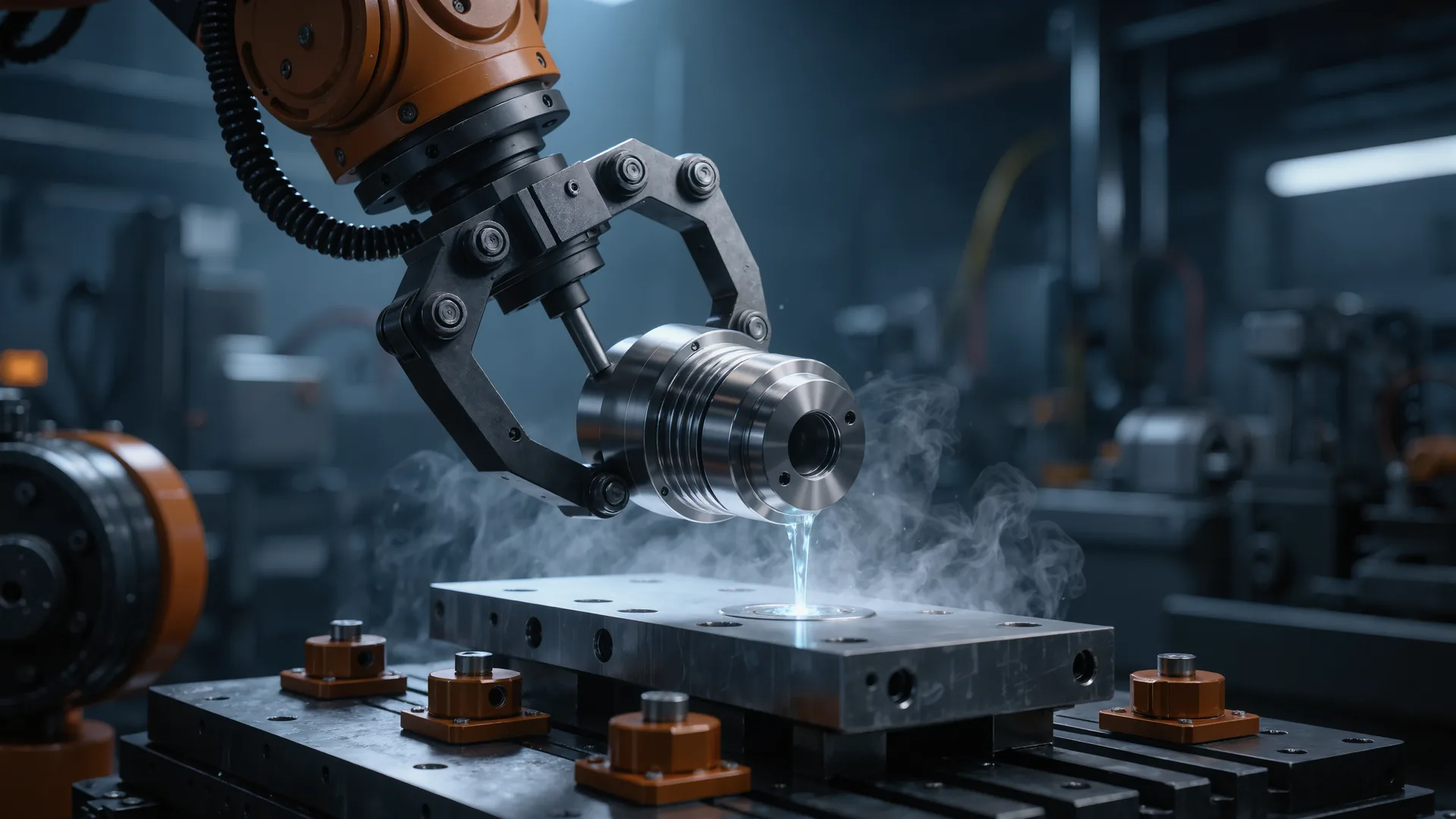
A single-machine tending cell lands between 70,000 and 190,000 euro installed, and the robot is typically only 20 % to 30 % of it. The lines that decide whether a project comes in on budget are the machine interface, the part presentation and the commissioning window, none of which appear prominently in a robot quotation.
The line items
| Item | Low | High | Driver |
|---|---|---|---|
| Robot, 10 to 20 kg class | 22,000 | 48,000 | Payload, reach, brand |
| Dual gripper and coupler | 4,500 | 18,000 | Two-station gripper, tool changer |
| Part presentation, trays or drawer | 6,000 | 32,000 | Part variety, autonomy target |
| Machine interface and controls | 4,000 | 20,000 | Age of the CNC, robot-ready or not |
| Automatic door and chuck actuation | 3,000 | 14,000 | Retrofit versus factory option |
| Guarding, scanners, interlocks | 3,500 | 16,000 | Layout and access requirements |
| Vision or presence checking | 0 | 18,000 | Part orientation, chuck verification |
| Base, pedestal or rail | 1,500 | 12,000 | Fixed versus seventh axis |
| Integration engineering | 14,000 | 45,000 | Interfaces and programming |
| Risk assessment and CE file | 2,500 | 8,000 | Complexity of the safety concept |
| Installation and commissioning | 5,000 | 16,000 | Downtime window, shift work |
| Training and documentation | 1,500 | 6,000 | Operator count |
| Installed total | 67,500 | 253,000 | Most projects land at 70,000 to 190,000 |
The four lines that blow up
- The machine interface. A CNC delivered with a robot interface option costs a few thousand to connect. A machine from 2004 without one needs door actuation, chuck confirmation, cycle-start handshake and often a safety-rated interface, and that is a controls project of 10,000 to 20,000 euro. Check the machine before quoting the robot.
- Part presentation and autonomy. The question is not how the robot picks the part, it is how many parts sit ready. A cell with 20 minutes of autonomy needs a person nearby, which removes most of the labour saving. Reaching 4 to 8 hours of unattended running usually means drawers, stacked trays or a pallet magazine, and that is where the 32,000 euro upper bound comes from.
- Commissioning downtime. The machine has to stop to be integrated. On a machine running two shifts, three days of downtime can cost more in lost output than the robot itself, which is why weekend and holiday commissioning premiums are worth paying.
- Chuck and fixture verification. Confirming the part is seated correctly before the spindle starts is not optional, and air-seat checks, presence sensors or a probe cycle add both cost and cycle time.
Payback, calculated honestly
Take a 120,000 euro cell replacing a single operator position across two shifts. At a fully loaded cost of 45,000 euro per shift-position, the gross saving is 90,000 euro a year and simple payback is 16 months. Three corrections usually apply.
- Utilisation. If the cell runs 65 % of available time, the saving falls to about 58,500 euro and payback stretches to 25 months.
- Residual supervision. Someone still loads magazines, clears jams and checks parts. Half a position is common, taking payback to roughly 33 months.
- Second machine. Extending the same robot to tend a second machine adds perhaps 25,000 to 40,000 euro and can nearly double the saving. This is the single strongest lever in the whole calculation.
Point three is why so many cells are designed around a rail or a central robot position from the start, even when only one machine is automated on day one.
Running cost
Energy is minor: a 10 kg to 20 kg class arm at typical duty draws roughly 0.3 kW to 1.2 kW, so a 4,000-hour year is 1,200 kWh to 4,800 kWh, or 240 to 960 euro at 0.20 euro per kWh. Service contracts commonly run 2 % to 5 % of hardware value per year. Gripper jaws and vacuum cups are consumables. The largest recurring cost is usually the engineering time to add each new part to the cell, which is why part families should be defined before the fixturing is designed.
Frequently asked questions
How much does a robotic machine tending cell cost?
Typically 70,000 to 190,000 euro installed for a single machine, with the robot itself accounting for 20 % to 30 %. Cells with high part variety or long unattended running requirements sit above that range.
Why is the machine interface so expensive?
An older CNC without a robot interface option needs automatic door actuation, chuck open and close control, seating confirmation and a cycle-start handshake, often with a safety-rated connection. That is a controls project rather than a cable.
What payback should I expect?
14 to 30 months for a well-scoped cell. Anything under 12 months in a proposal usually assumes full utilisation and no residual supervision, both of which are optimistic.
Can one robot tend two machines?
Often yes, and it is the strongest economic lever available. Adding a second machine to an existing robot typically costs 25,000 to 40,000 euro and can nearly double the labour saving, provided cycle times leave the robot idle time to exploit.
How long does installation take?
Six to fourteen weeks from order to production. The constraint is usually the availability of the machine for integration rather than robot lead time, which is why commissioning is often scheduled for shutdown periods.
Sources
- World Robotics 2025, industrial robotsInternational Federation of Robotics, installation volumes and application mix
- ISO 10218-1:2025, Robotics, Safety requirements, Part 1International Organization for Standardization, integration and validation duties
- Regulation (EU) 2023/1230 on machineryEU-OSHA, conformity assessment obligations driving the CE file line