Humanoids and Legged Robots
Quadruped vs Wheeled Robots for Plant Inspection
A legged inspection robot costs three to six times a wheeled one and earns it only on stairs and grating. Here is the site survey that decides which you need.
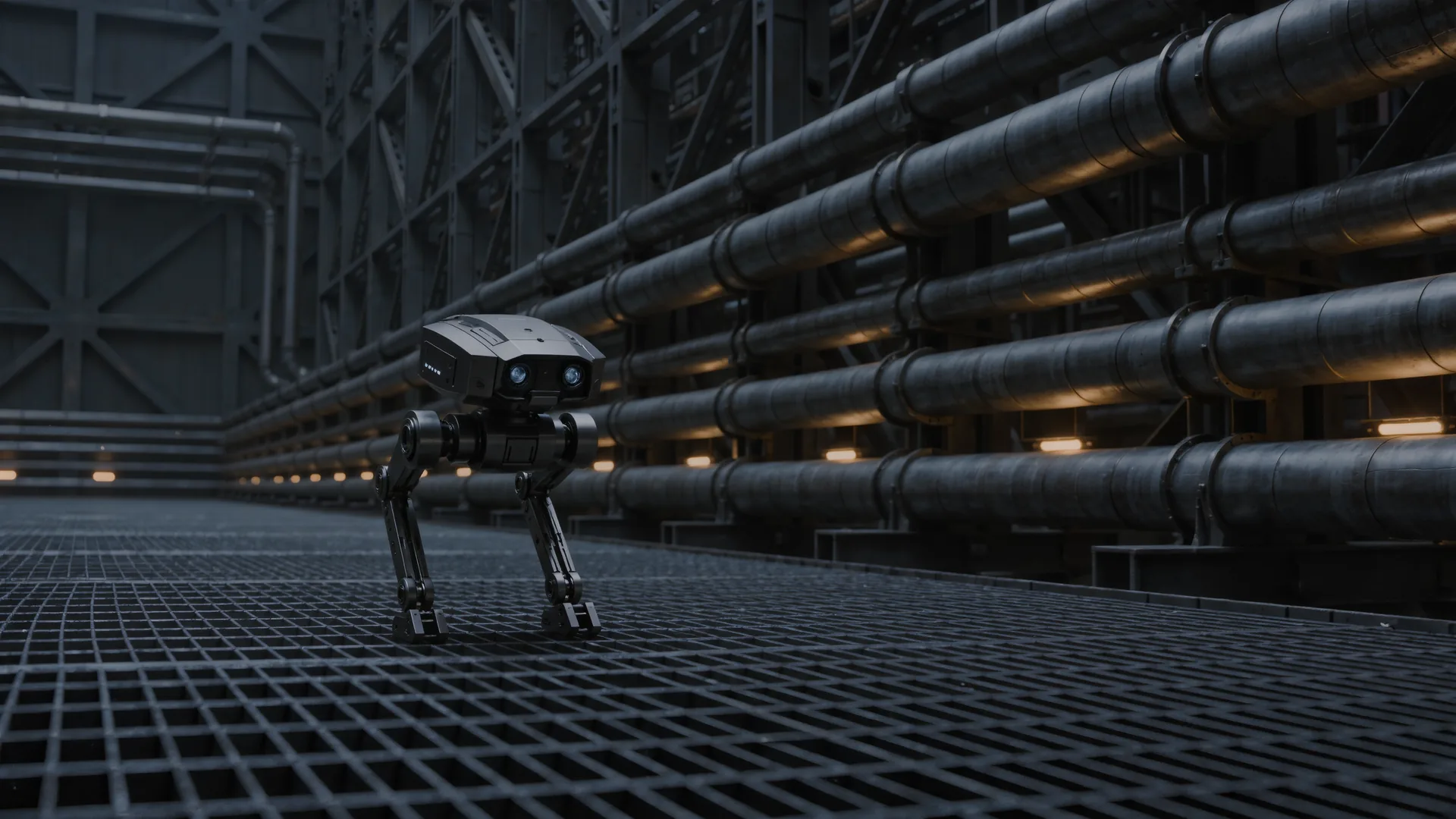
Count the steps and the grating. If the inspection route has neither, a wheeled or tracked platform does the same job at roughly a third of the price, with two to four times the runtime and a mature safety framework. Quadrupeds earn their premium on stairs, open mesh flooring, cable trays and 200 mm kerbs, which is a real but narrow set of routes.
The comparison that matters
| Property | Quadruped | Wheeled | Tracked |
|---|---|---|---|
| Stairs | Yes | No | Some, shallow only |
| Open grating | Yes, with foot design | Poor, wheels drop in | Good |
| Kerbs and thresholds | up to 300 mm | up to 30 mm | up to 150 mm |
| Runtime | 60 to 120 min | 4 to 12 h | 3 to 8 h |
| Payload for sensors | 5 to 14 kg | 20 to 100 kg | 20 to 80 kg |
| Speed on flat ground | 1.0 to 1.6 m/s | 1.0 to 2.0 m/s | 0.6 to 1.2 m/s |
| Noise | Noticeable footfall | Quiet | Loud on hard floors |
| Floor damage risk | Low | Low | Moderate |
| Relative purchase price | 3 to 6 | 1 | 1.5 to 2.5 |
The runtime row is the operational one. A quadruped completing a 45 minute round needs to dock and charge before the next, so a continuous inspection regime requires either two robots or a shorter route. A wheeled platform with 8 hours of endurance runs the same route repeatedly without intervention.
The site survey that decides it
- Walk the route and count steps. Note every riser above 30 mm. Many of them turn out to be three specific thresholds that can be ramped.
- Photograph every floor surface change. Open grating, chequer plate, gravel, drainage channels and cable trays each behave differently.
- Measure the narrowest passage. A quadruped needs roughly 700 mm to 900 mm; a wheeled platform with a sensor mast can need more or less depending on design.
- Locate power. Charging dock positions constrain the route more than the robot does.
- Check the atmosphere classification. Zones requiring explosion protection rule out most platforms of either type and dominate the decision entirely.
Step five deserves emphasis. In chemical, oil and gas contexts, explosion protection certification is the gate. It narrows the field to a handful of certified platforms, and the legs-versus-wheels question becomes secondary to what is available with the right certificate.
Where the value actually comes from
The robot is a data collection device, and the return comes from what the data prevents. Typical inspection rounds check gauge readings, thermal signatures on motors and switchgear, gas concentrations, leaks, vibration and general condition. Automating the round produces two benefits that a human round rarely delivers.
- Frequency. A route walked once a shift by a human can be walked every 90 minutes by a robot, and early detection of a bearing heating up is worth more than the inspection cost many times over.
- Consistency. The robot photographs the same gauge from the same position every time, which makes trend analysis possible. Human rounds vary in angle, lighting and diligence.
Both benefits are available from a wheeled platform on a flat route. Neither requires legs. The legs question is only about which routes are reachable at all.
Sensor payloads and what they weigh
| Instrument | Mass | Power | Detects |
|---|---|---|---|
| Pan-tilt-zoom visual camera | 1.2 to 3.0 kg | 10 to 25 W | Gauges, valve positions, leaks |
| Thermal camera | 0.4 to 1.5 kg | 5 to 15 W | Hot bearings, loose connections |
| Acoustic imaging array | 1.5 to 3.5 kg | 15 to 30 W | Compressed air and gas leaks |
| Multi-gas detector | 0.5 to 1.2 kg | 2 to 8 W | Methane, hydrogen sulphide, oxygen |
| Lidar for mapping | 0.8 to 2.5 kg | 8 to 20 W | Navigation and change detection |
| Edge compute and radio | 0.6 to 2.0 kg | 20 to 60 W | On-board analysis and upload |
| Full package | 5.0 to 13.7 kg | 60 to 158 W |
A complete package sits right at the top of a quadruped's payload allowance and comfortably inside a wheeled platform's. The power column matters too: 158 W of instruments on a legged robot already drawing several hundred watts to stand shortens an hour-long round noticeably.
Frequently asked questions
When is a quadruped worth the extra cost?
When the route includes stairs, open grating, cable trays or thresholds above roughly 30 mm that cannot be ramped. On flat routes a wheeled platform delivers the same data at a third of the price with far longer runtime.
How long does an inspection quadruped run?
Typically 60 to 120 minutes per charge, against 4 to 12 hours for wheeled platforms. Continuous inspection regimes therefore need either two legged robots or a shorter route with a docking break.
How much sensor payload can each carry?
Quadrupeds commonly allow 5 kg to 14 kg, wheeled platforms 20 kg to 100 kg. Since thermal cameras, gas detectors and acoustic arrays add up quickly, payload allowance often decides which instruments fit on the round.
Can these robots work in explosive atmospheres?
Only certified platforms can, and certification narrows the field to a handful of models. In classified zones the certificate is the first filter, and the choice between legs and wheels comes second.
Where does the return on investment come from?
From frequency and consistency rather than from labour saving. A route walked every 90 minutes with identical camera positions produces trend data that a variable human round cannot, and early fault detection is where the value sits.
Sources
- ROBOTS guide, legged and mobile platform profilesIEEE Spectrum, published runtime, payload and speed figures
- ISO 3691-4, safety requirements for driverless industrial trucksInternational Organization for Standardization, covers wheeled inspection platforms
- ISO 13482, safety requirements for personal care robotsInternational Organization for Standardization, the nearest framework addressing legged machines