Actuators and Mechanics
BLDC vs Stepper Motors in Robot Joints
Steppers are cheap, simple and open loop. Brushless motors are efficient, quiet and closed loop. Where each still wins in robotics, with the torque and heat numbers.
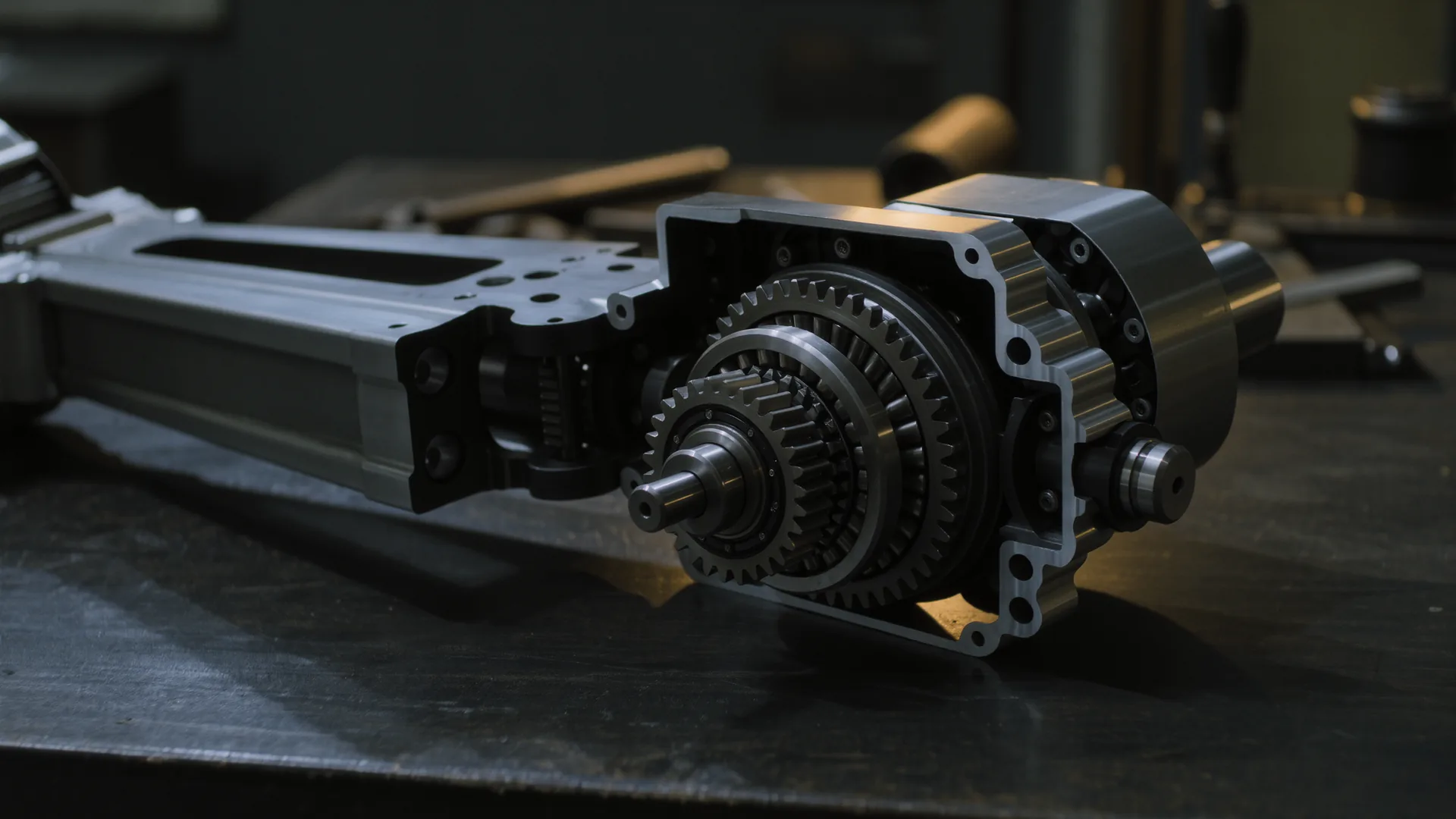
Steppers win on cost and simplicity for holding tasks at low speed: they produce full torque at zero speed with no feedback and no tuning. Brushless motors win almost everywhere else, and decisively above roughly 500 rpm, where stepper torque collapses. The deciding factor in a robot joint is usually heat: a stepper draws full current while holding position and turns most of it into heat.
Side by side
| Property | Stepper | Brushless DC |
|---|---|---|
| Torque at zero speed | full, open loop | full, needs current control |
| Torque at 1,000 rpm | 20 to 50 % of holding | near rated |
| Efficiency | 30 to 60 % | 85 to 95 % |
| Holding current | full rated | proportional to load |
| Feedback required | No, though closed loop is common | Yes, commutation needs position |
| Resolution without a gearbox | 200 to 51,200 steps/rev | encoder dependent |
| Audible noise | noticeable, resonant | low |
| Failure mode | Silent step loss | Detected fault |
| Relative drive cost | 1 | 2 to 4 |
The heat argument
A stepper holding a position draws its full rated current regardless of the load, because that is how it generates holding torque. A joint holding a light load for 20 seconds between moves therefore dissipates the same power as one working hard. In a sealed robot arm this is a genuine problem: the heat has nowhere to go, the motor temperature rises, and torque derates as the winding resistance climbs.
A brushless servo draws current proportional to the actual load, so a joint holding a small torque draws a small current. Over a duty cycle with substantial dwell time, which describes most robot work, the difference in total energy and in steady-state temperature is large.
Worked comparison on one joint
Take a small robot joint that must hold 4 Nm at the output through a 50:1 gearbox, so about 0.08 Nm at the motor, with a duty cycle of 30 % motion and 70 % holding.
| Quantity | Stepper | Brushless servo |
|---|---|---|
| Motor holding current | 2.0 A, full rated | 0.35 A, load proportional |
| Resistive loss while holding, 1.2 ohm winding | 4.8 W | 0.15 W |
| Loss over 70 % of an hour | 3.4 Wh | 0.10 Wh |
| Motor temperature rise, sealed housing | 35 to 60 K | 8 to 15 K |
| Torque available at 800 rpm | 30 to 45 % of holding | 90 to 100 % of rated |
| Energy for a 4,000 hour year | 13.4 kWh | 0.4 kWh |
| Drive and feedback cost | 1.0x | 2 to 4x |
The energy difference is small in absolute terms and the temperature difference is not. A 35 K to 60 K rise inside a sealed arm is the whole argument, because it derates torque, degrades grease and shortens bearing life at the same time.
Where steppers still make sense
- Low-cost educational and hobby arms. Simplicity and price dominate, and duty cycles are light.
- Auxiliary axes with light loads. Tool changers, indexers, small linear stages, camera focus drives.
- Open-loop positioning where step loss is detectable by a limit switch or an end-of-travel check.
- Very high resolution without a gearbox. Microstepping gives fine positioning directly, useful in laboratory and instrumentation contexts.
- Systems that must hold with no power electronics active, where a detent torque of a few percent of rating is enough.
The middle option
| Property | Open-loop stepper | Closed-loop stepper | Brushless servo |
|---|---|---|---|
| Step loss detected | No | Yes | Not applicable |
| Current at low load | full | reduced | proportional |
| High-speed torque | poor | poor | good |
| Tuning effort | none | low | moderate |
| Relative cost | 1 | 1.3 to 1.8 | 2 to 4 |
Closed-loop steppers add an encoder and current reduction, which fixes the two worst characteristics without the cost or tuning of a full servo. They remain poor at speed, because that limitation is inherent to the winding inductance rather than to the control scheme.
Frequently asked questions
Why do industrial robots use brushless motors?
Efficiency, high-speed torque, low heat while holding, and detected rather than silent failures. A stepper draws full current to hold any load and loses most of its torque above roughly 500 rpm.
What is silent step loss?
An overloaded stepper skipping steps without reporting it, so the controller believes the axis reached the commanded position while the machine did not. Every following move inherits the error, and nothing raises a fault.
Are steppers ever the right choice in robotics?
Yes, for low-cost arms, auxiliary axes with light loads, and applications needing fine open-loop resolution without a gearbox. They suit holding tasks at low speed with light duty cycles.
What does a closed-loop stepper fix?
Step loss detection and current reduction at low load, which removes the two worst characteristics at 1.3 to 1.8 times the cost. High-speed torque remains poor because that limit comes from winding inductance.
Why does a stepper get hot doing nothing?
Because holding torque requires full rated current regardless of load. In a sealed robot arm the resulting heat has nowhere to go, motor temperature rises, and available torque derates as winding resistance increases.
Sources
- ISO 8373, robotics vocabularyInternational Organization for Standardization, actuator and joint terminology
- ISO 9283, manipulating industrial robots, performance criteria and test methodsPositioning performance definitions affected by step loss
- ROBOTS guideIEEE Spectrum, actuator choices across commercial robot designs