Actuators and Mechanics
Aluminium, Steel, Carbon: What Robot Arms Are Made Of
Material choice sets stiffness, mass and cost in a robot arm. Why cast aluminium dominates, where steel and carbon fibre appear, and what specific stiffness actually means.
Cast aluminium dominates because it wins on specific stiffness, the ratio of stiffness to density, at a cost castings can deliver in volume. Steel is stiffer in absolute terms and about 2.9 times denser, so a steel link of equal stiffness weighs more and slows the arm. Carbon fibre beats both on specific stiffness by a wide margin and is used only where the cost is justified, which in practice means long-reach and high-speed machines.
Specific stiffness is the right metric
A robot link must resist deflection while being accelerated by the joint below it. Adding material increases stiffness and also mass, and mass costs torque everywhere down the chain. The relevant figure is therefore stiffness divided by density, not stiffness alone.
| Material | Modulus | Density | Specific stiffness | Relative cost |
|---|---|---|---|---|
| Aluminium alloy | 70 GPa | 2.7 g/cm³ | 26 | 1.0 |
| Steel | 200 GPa | 7.85 g/cm³ | 25 | 0.6 |
| Cast iron | 110 GPa | 7.2 g/cm³ | 15 | 0.5 |
| Magnesium alloy | 45 GPa | 1.8 g/cm³ | 25 | 2 to 4 |
| Carbon fibre composite | 70 to 200 GPa | 1.6 g/cm³ | 44 to 125 | 5 to 15 |
| Engineering polymer | 2 to 10 GPa | 1.1 to 1.4 g/cm³ | 2 to 8 | 0.3 to 1 |
Aluminium and steel have almost identical specific stiffness, which surprises people. The reason aluminium wins is not the ratio but everything around it: castings are cheap in volume, machining is faster, thermal conductivity helps remove motor heat, and thicker sections for the same mass give better buckling resistance and easier internal cable routing.
Where each material appears
- Cast aluminium. Almost all industrial arm links and housings. Cheap in volume, good thermal path, easy to cast complex internal geometry for cable routing.
- Steel. Bases, mounting flanges, gearbox housings and anywhere absolute stiffness and wear resistance matter more than mass, since the base is not accelerated.
- Cast iron. Heavy machine bases where damping matters, as it does in machine tools.
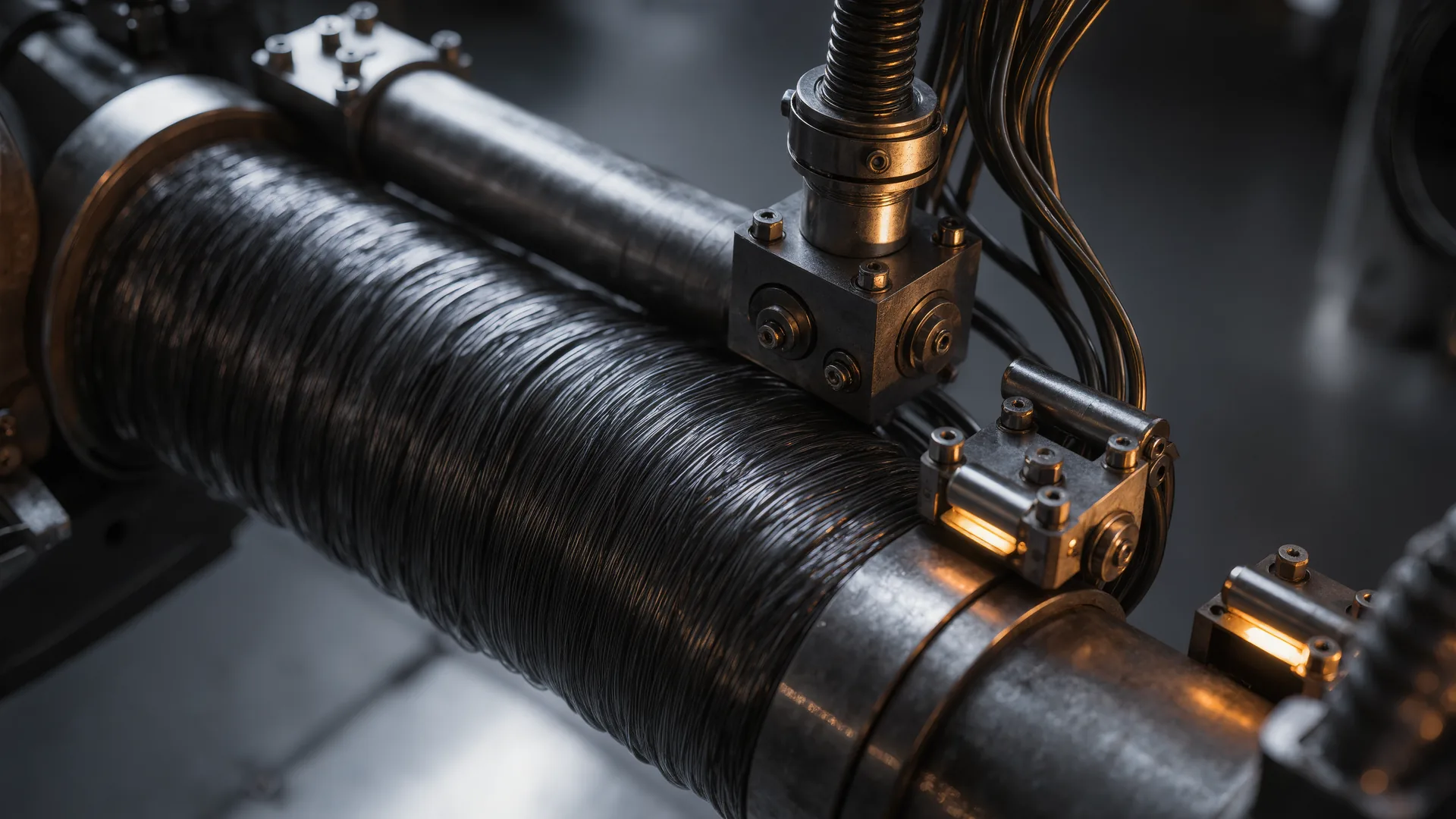
- Carbon fibre. Long-reach links, high-speed delta arms, and lightweight collaborative and humanoid structures, where every kilogram saved compounds up the chain.
- Engineering polymer. Covers, shrouds and low-load structures on small and educational arms.
- Magnesium. Occasional use where mass matters and carbon fibre is too expensive, at the cost of corrosion sensitivity.
How the parts are actually made
| Route | Tooling cost | Economic volume | Suits |
|---|---|---|---|
| High pressure die casting | high | above 2,000 per year | Industrial arm links and housings |
| Sand or investment casting | low to moderate | 50 to 2,000 | Prototypes, low-volume arms |
| Machined from billet | none | 1 to 200 | Prototypes, precision interfaces |
| Extruded profile plus machined ends | low | any | Straight links, gantries |
| Carbon fibre tube plus bonded fittings | moderate | 10 to 5,000 | Long-reach and high-speed links |
| Metal additive manufacturing | none | 1 to 100 | Topology-optimised brackets, one-offs |
The extrusion route is the underused one for low-volume builders. A stiff aluminium tube with machined end fittings reaches most of the performance of a casting without any tooling investment, which is why it dominates gantries and appears in almost every prototype arm.
The property nobody specifies and everybody feels
Thermal expansion changes the arm's dimensions as it warms. Aluminium expands roughly 23 micrometres per metre per kelvin, steel about 12, and carbon fibre composites can be engineered near zero. A 1 m aluminium link warming by 10 K grows about 0.23 mm, which is an order of magnitude larger than the robot's repeatability specification.
This is why precision cells warm up before the first good part, and why a robot calibrated cold produces a systematic offset once hot. On a carbon fibre link the effect is much smaller, which is a genuine and rarely mentioned advantage for metrology and inspection robots.
Frequently asked questions
Why are robot arms made of aluminium?
Because its specific stiffness matches steel while castings are cheap in volume, machining is fast, the thermal path helps remove motor heat, and thicker sections at the same mass allow easier internal cable routing.
Is steel stiffer than aluminium?
In absolute terms yes, at about 200 GPa against 70 GPa, and it is also 2.9 times denser. Divided by density the two are almost equal, so a steel link of equal stiffness weighs considerably more and slows the arm.
Why is carbon fibre not used everywhere?
Cost, typically 5 to 15 times a metal part, plus difficulty in joining, in machining precise interfaces and in inspecting for internal damage. It appears where saved mass compounds, such as long-reach links and high-speed arms.
Does material affect accuracy?
Yes, through thermal expansion. Aluminium expands roughly 23 micrometres per metre per kelvin, so a 1 m link warming 10 K grows about 0.23 mm, an order of magnitude beyond typical repeatability. Carbon fibre can be engineered near zero.
Can I make a link stiffer without changing material?
Usually yes, and it is the better move. Bending stiffness scales with the fourth power of tube diameter, so a 20 % larger section roughly doubles stiffness at the same wall thickness.
Sources
- ISO 9283, manipulating industrial robots, performance criteria and test methodsAccuracy specifications affected by structural deflection and thermal expansion
- ISO 8373, robotics vocabularyInternational Organization for Standardization, structural terminology
- Robotics at NISTNational Institute of Standards and Technology, robot performance measurement and test methods