Actuators and Mechanics
Harmonic vs Cycloidal Drives: Backlash, Life, Price
Two gearbox families dominate robot joints. Harmonic drives are light and precise, cycloidal drives are stiff and take shock. Which belongs where, with the numbers.
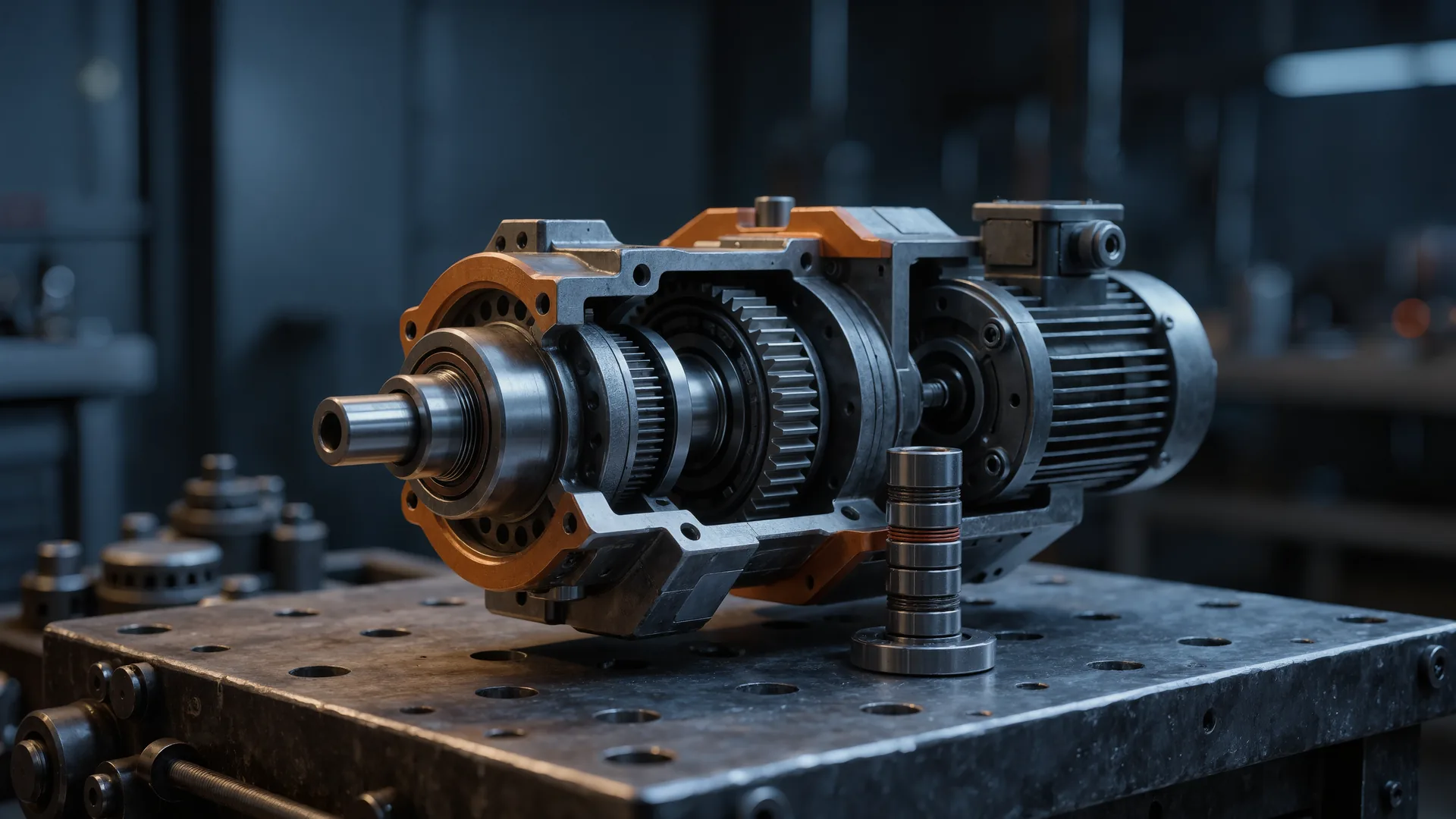
Harmonic drives go in wrists and light arms: near-zero backlash under one arcminute, ratios from 30:1 to 320:1 in one stage, and low mass. Cycloidal drives go in shoulders, elbows and heavy joints: higher torsional stiffness, shock capacity typically 3 to 5 times rated torque, and longer life under load. The two are not competitors so much as occupants of different positions on the same arm.
How each one works
A harmonic drive uses three parts: a rigid circular spline with internal teeth, a flexible cup with slightly fewer external teeth, and an elliptical wave generator that deforms the cup so its teeth engage at two opposite points. Each revolution of the wave generator advances the flexspline by the small tooth difference, which produces a high ratio in one compact stage with no backlash, because the teeth are always in engagement under preload.
A cycloidal drive uses an eccentric input driving one or two cycloidal discs against a ring of pins. Many pins carry load simultaneously, which is why the design tolerates shock well and offers high torsional stiffness. Backlash is small but not zero, typically under one arcminute on precision units and larger on general-purpose ones.
| Property | Harmonic drive | Cycloidal drive |
|---|---|---|
| Backlash | under 1 arcmin, effectively zero | under 1 to 3 arcmin |
| Single-stage ratio | 30:1 to 320:1 | 6:1 to 200:1 |
| Torsional stiffness | moderate | high |
| Shock capacity | 2 to 3x rated | 3 to 5x rated |
| Mass for a given torque | low | higher |
| Efficiency | 70 to 85 % | 85 to 93 % |
| Rated life | 7,000 to 20,000 h | 6,000 to 20,000 h |
| Hollow shaft option | standard | common |
| Typical position on an arm | Wrist, forearm, small arms | Base, shoulder, elbow, heavy arms |
How each one fails
- Harmonic drive. Flexspline fatigue cracking from repeated deformation, accelerated by exceeding the rated momentary torque. Wave generator bearing wear. Both develop gradually and appear first as rising backlash and audible ratcheting under load.
- Cycloidal drive. Pin and disc surface fatigue, and bearing wear at the eccentric. Also gradual, appearing as increased backlash and vibration at specific speeds.
- Both. Lubricant degradation is the most common root cause. Grease breaks down with temperature and time, and a gearbox run past its grease interval fails far earlier than its rated life.
Specifying one properly
- Average torque, not peak. Life is calculated from the load duty cycle, so a spreadsheet of torque against time is required, not a single number.
- Momentary peak torque. Emergency stops and collisions produce the highest loads a gearbox ever sees, and exceeding the momentary rating even once damages a flexspline.
- Average input speed. Life scales inversely with it, and this is where a demanding cycle quietly halves a rated figure.
- Moment load on the output bearing. A long overhung tool loads the output bearing, and this is a separate calculation from torque.
- Ambient temperature. Grease life falls sharply with temperature, and a foundry or a sealed enclosure changes the maintenance interval.
The third and fourth options
Two other transmissions appear in robot joints, and knowing why they lose helps explain why the first two dominate.
| Type | Backlash | Efficiency | Hollow shaft | Where it appears |
|---|---|---|---|---|
| Harmonic | under 1 arcmin | 70 to 85 % | standard | Wrists, light arms, cobots |
| Cycloidal | under 1 to 3 arcmin | 85 to 93 % | common | Base, shoulder, heavy joints |
| Precision planetary | 1 to 8 arcmin | 90 to 97 % | rare | External axes, positioners, grippers |
| Belt and pulley | depends on tension | 92 to 98 % | n/a | Moving motor mass off the joint |
Planetary gearboxes are more efficient and cheaper than either precision family, and they rarely offer the hollow bore a robot wrist needs. Belts are the most efficient of all and are used to relocate motor mass toward the base, which reduces inertia at the cost of a tensioning maintenance item and a stretch that shows up as position error.
The supply constraint
Precision reducers are the tightest bottleneck in the robot supply chain. A very small number of specialists supply most of the world's harmonic and cycloidal units, historically concentrated in Japan, and lead times for these components have repeatedly constrained robot production. Several robot builders have invested in gearbox capacity for precisely that reason, and any programme planning volume production should treat reducer supply as a scheduling risk rather than a purchasing detail.
Frequently asked questions
Which gearbox has less backlash?
Harmonic drives, at effectively zero and specified under one arcminute, because their teeth remain engaged under preload. Precision cycloidal units reach under one arcminute as well, but general-purpose ones are typically higher.
Why are cycloidal drives used at the shoulder?
Because many pins share the load simultaneously, giving higher torsional stiffness and shock capacity of three to five times rated torque. Shoulder joints see the highest loads and the worst emergency-stop transients on an arm.
What actually kills a robot gearbox?
Lubricant degradation more often than mechanical fatigue. Grease breaks down with temperature and running hours, and a unit operated past its grease interval fails well before its rated life.
How do I size a reducer?
From the duty cycle, not the peak: average torque, average input speed, momentary peak torque, output moment load and ambient temperature. Life calculations depend on all five, and speed is the term most often underestimated.
Why is a hollow shaft important?
Because cables, air lines and coolant must pass through rotating joints. Both harmonic and cycloidal families offer a central bore, which is a principal reason they dominate robot joints over otherwise capable planetary gearboxes.
Sources
- ISO 9283, manipulating industrial robots, performance criteria and test methodsRepeatability and accuracy definitions affected by gearbox backlash
- World Robotics 2025, industrial robotsInternational Federation of Robotics, production volumes that determine reducer demand
- ISO 8373, robotics vocabularyInternational Organization for Standardization, joint and transmission terminology