Mobile Robots
Opportunity Charging vs Battery Swap for Mobile Robots
Three charging strategies for mobile robot fleets, with the availability arithmetic that decides between them and the lithium chemistry differences that change the answer.
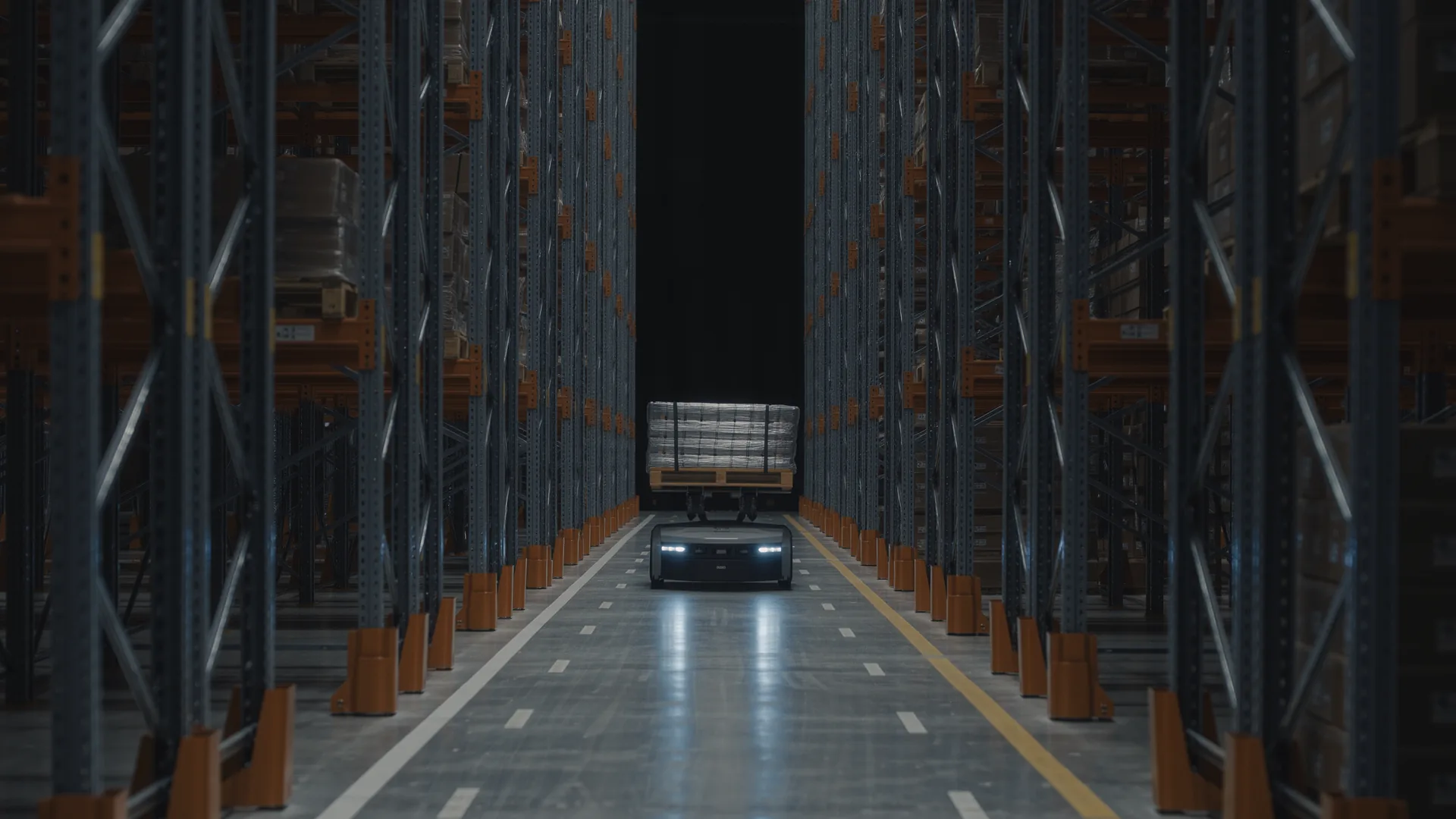
For fleets under about 30 vehicles, opportunity charging almost always wins: the robot tops up for 3 to 8 minutes whenever it idles, and fleet availability stays above 95 % with one charger per 3 to 5 robots. Battery swap only pays when duty cycles exceed roughly 90 % and there is no idle time to exploit, and it brings a manual handling task back into an automated process.
The three strategies
| Strategy | How it works | Fleet availability | Best for |
|---|---|---|---|
| Full charge cycles | Run to a low threshold, charge to full, return | 80 to 88 % | Small fleets, single shift |
| Opportunity charging | Short top-ups during natural idle time | 93 to 98 % | Most fleets, multi-shift |
| Battery swap | Depleted pack exchanged for a charged one | 96 to 99 % | Near-continuous duty, large fleets |
The availability arithmetic
Take a robot with a 1.2 kWh usable pack consuming an average of 190 W in mixed duty. That gives roughly 6.3 hours of running. Charging at 1.2 kW from 20 % to 90 % moves 0.84 kWh, which takes about 42 minutes plus taper.
- Full cycle strategy: 6.3 h run, 0.7 h charge, plus travel to and from the charger. Availability is about 6.3 / 7.2 = 87 %.
- Opportunity strategy: if the robot idles 6 minutes in every hour anyway, charging during those windows adds roughly 0.12 kWh per hour at 1.2 kW, which covers 63 % of consumption. Only the remainder needs dedicated charging, and availability rises to 95 % to 97 %.
- Swap strategy: a 90-second exchange every 6 hours is 0.4 % downtime, so availability is limited by something else entirely.
The insight is that opportunity charging converts existing idle time into charge time. If the fleet has no idle time, it delivers nothing, which is precisely the condition under which swap becomes attractive.
Chemistry changes the answer
| Chemistry | Cycle life | Energy density | Behaviour |
|---|---|---|---|
| Lithium iron phosphate (LFP) | 2,000 to 6,000 | 90 to 160 Wh/kg | Tolerates partial charging well, safest thermal behaviour |
| Lithium nickel manganese cobalt (NMC) | 1,000 to 2,500 | 150 to 250 Wh/kg | Lighter for the same energy, more sensitive to high state of charge |
| Lithium titanate (LTO) | 10,000 to 20,000 | 50 to 80 Wh/kg | Very fast charge, heavy and expensive |
| Lead acid | 300 to 800 | 30 to 50 Wh/kg | Cheap, dislikes partial charging, largely displaced |
LFP is the mainstream choice for opportunity charging because partial cycles do not shorten its life the way they punish lead acid. Keeping cells between roughly 20 % and 80 % state of charge, rather than cycling to the extremes, typically extends usable life by 30 % to 60 % on lithium chemistries.
Practical fleet rules
- Size chargers at one per 3 to 5 robots for opportunity charging, more if idle windows are short.
- Charge to 80 %, not 100 %. The last 20 % takes disproportionately long because of the taper and it costs cycle life.
- Make charging a fleet decision, not a robot decision. A central manager that assigns charging by predicted demand avoids the failure mode where six robots queue at one charger while four sit idle elsewhere.
- Watch temperature. Charging below 0 °C damages lithium cells, which matters in cold stores and unheated docks. Heated packs or a warm-up cycle are needed there.
- Plan pack replacement. At 2,000 cycles and roughly one cycle a day, an LFP pack reaches end of useful life in five to six years, which is inside the expected service life of the vehicle.
Frequently asked questions
Is opportunity charging bad for the battery?
Not with lithium iron phosphate, which handles partial cycles well. Keeping the pack between roughly 20 % and 80 % state of charge typically extends usable life by 30 % to 60 % compared with full deep cycling.
When does battery swapping pay off?
When duty cycles exceed roughly 90 % so there is no idle time to exploit, and when the fleet is large enough to justify swap infrastructure and spare packs. It reintroduces a handling task, which is a real cost in an otherwise automated process.
How many chargers does a fleet need?
One per three to five robots for opportunity charging, placed where robots naturally wait. Charger placement matters more than charger power, because travel to a distant charger cancels the benefit of a short top-up.
Why not charge to 100 percent?
The final 20 % charges slowly because of current taper, so it consumes disproportionate charger time, and high state of charge accelerates ageing on lithium chemistries. Charging to about 80 % is the usual compromise.
What happens in a cold store?
Charging lithium cells below 0 °C causes lasting damage. Cold store fleets need heated packs, a warm-up cycle before charging, or chargers located in a temperate area outside the cold zone.
Sources
- ISO 3691-4, safety requirements for driverless industrial trucksInternational Organization for Standardization, requirements for charging and battery systems
- IEC 62619, safety requirements for secondary lithium cells and batteries for industrial applicationsInternational Electrotechnical Commission
- World Robotics, service robots report seriesInternational Federation of Robotics, logistics fleet deployment data