Mobile Robots
Mobile Manipulators: Where They Beat Fixed Cells
A mobile manipulator is an arm on a mobile base, and it only pays where the work is spread out and low volume. Here is the decision rule and the accuracy problem nobody mentions.
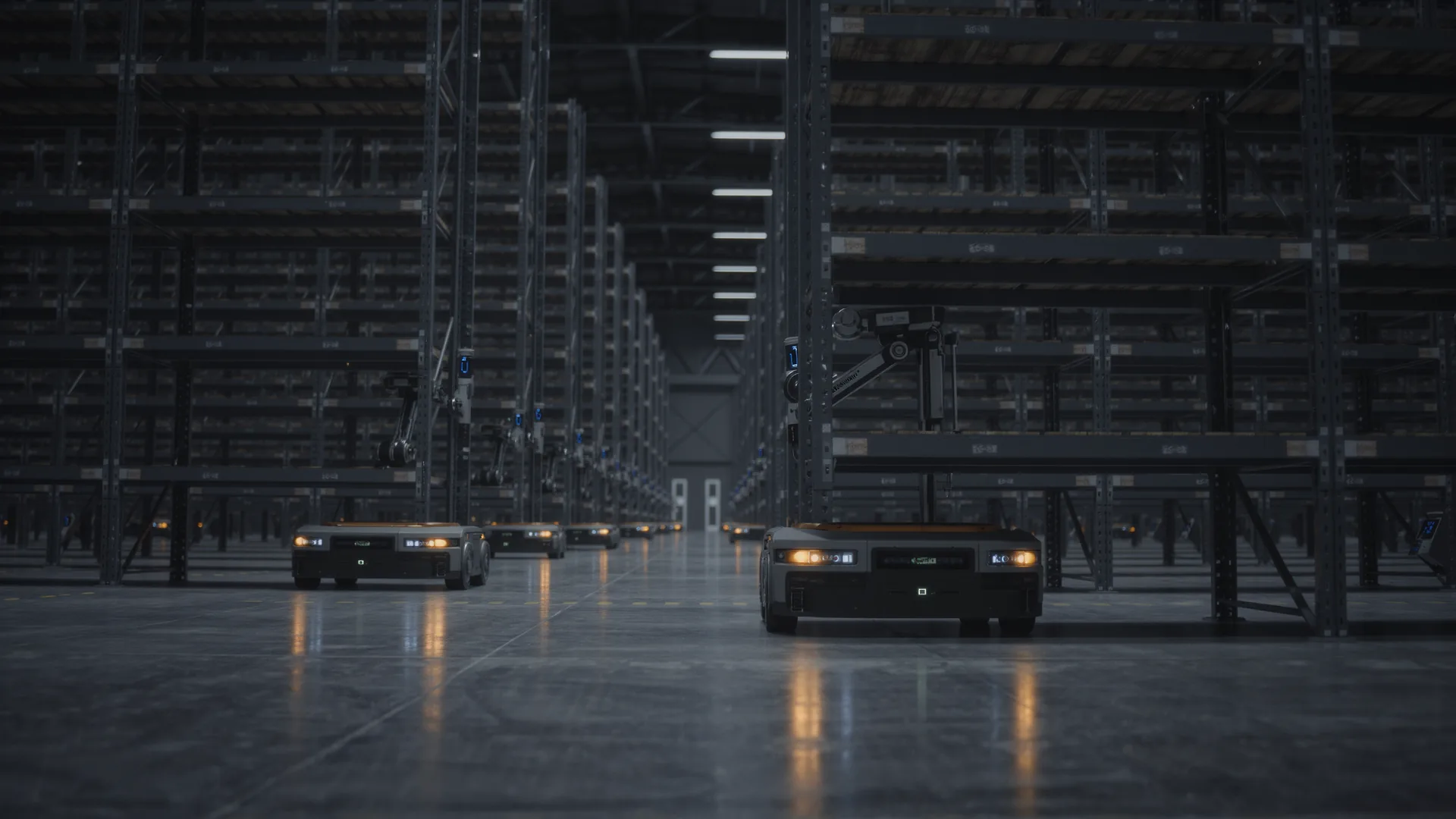
A mobile manipulator pays when the work is spread across many stations at low volume each. The rule of thumb: if any single station needs more than roughly 25 % of a shift, a fixed arm at that station is cheaper and faster. Below that, one mobile unit visiting eight stations beats eight fixed cells, and the deciding constraint is not mobility but docking accuracy.
The economics, plainly
A mobile manipulator costs roughly two to four times a comparable fixed arm once the base, the fleet software and the docking infrastructure are included. It replaces N fixed cells only if it can visit all N within the takt, and travel time is dead time that a fixed arm never pays.
Worked case: eight machines each needing 4 minutes of tending per hour. Fixed cells would need eight arms at 32 minutes of total work per hour, or 6.7 % utilisation each, which is obviously wasteful. One mobile unit needs 32 minutes of work plus 8 travel legs at 60 s, so 40 minutes per hour, or 67 % utilisation. That works, and it replaces eight arms with one.
Change one number and it collapses. If each machine needs 12 minutes per hour, total work is 96 minutes plus travel, which exceeds the hour. Now two mobile units are needed, and two mobile units cost roughly the same as five to eight fixed arms while running slower.
The accuracy problem
A fixed arm knows where the fixture is because it was taught there. A mobile arm arrives with a pose error of roughly ±10 mm to ±50 mm and several tenths of a degree in heading, and that error propagates directly into every taught point. Three approaches resolve it, and every serious deployment uses one.
| Method | Residual error | Time cost | Note |
|---|---|---|---|
| Mechanical docking funnel | ±0.5 to 2 mm | 2 to 6 s | Cheapest, needs floor hardware at each station |
| Vision fiducial on the fixture | ±0.2 to 1 mm | 1 to 3 s | Camera on the arm, marker on the station |
| Touch probing of known features | ±0.05 to 0.3 mm | 4 to 15 s | Slowest, most accurate, no added hardware |
| No compensation | ±10 to 50 mm | 0 s | Only viable with compliant tooling and wide targets |
Where it genuinely fits
- Laboratory automation. Many instruments, each used briefly, samples moved between them. Low forces, wide tolerances and high station count make this the strongest case.
- Machine tending across a spread-out shop. Especially where machines run long cycles and need attention only at start and finish.
- Kitting and line-side supply. Picking components into a kit and delivering it, combining transport with manipulation in a single trip.
- Inspection and metrology rounds. Carrying a sensor to fixed points on a schedule, where the payload is data rather than parts.
- Low-volume, high-mix assembly. Where reconfiguring a fixed cell for each variant would cost more than the production run.
Where it does not fit
- High force tasks. Pressing, drilling and heavy insertion push against a base that is not bolted down. Reaction forces move the vehicle, and the arm's own accuracy becomes irrelevant.
- Tight takt times. Travel time between stations is 30 s to 90 s and cannot be removed.
- Heavy payloads. Payload on a mobile base is limited by tipping stability, not by arm torque, so usable payload is often well below the arm's rating.
- Single high-utilisation station. If one station consumes most of the shift, mobility buys nothing and costs money.
The tipping constraint is worth spelling out. A 10 kg arm fully extended on a 500 kg base creates a moment that the base must resist. Manufacturers therefore restrict arm extension while driving, and sometimes restrict payload while extended, which means the datasheet payload of the arm and the usable payload of the system are different numbers.
Frequently asked questions
When is a mobile manipulator better than fixed cells?
When work is spread across many stations and no single station needs more than roughly 25 % of a shift. One mobile unit visiting eight lightly loaded stations replaces eight underused fixed arms.
How accurate is a mobile manipulator?
The base arrives within roughly ±10 mm to ±50 mm, so the arm inherits that error. With a docking funnel, a vision fiducial or touch probing at the station, residual error falls to between ±0.05 mm and ±2 mm depending on the method.
Can a mobile manipulator do high-force work?
Generally no. Reaction forces push against an unanchored base, so pressing, drilling and heavy insertion are poor fits. Tasks with forces under a few tens of newtons are the practical range.
What payload can it carry?
Less than the arm's rating, because tipping stability governs. Manufacturers commonly limit arm extension while driving and reduce permissible payload when extended, so the system payload has to be read from the combined specification.
What is the biggest hidden cost?
Station preparation. Each station needs a docking feature, a marker or a compliant fixture, plus the safety assessment for an arm operating in an open area. That work multiplies by the number of stations.
Sources
- Robotics at NISTNational Institute of Standards and Technology, robot performance measurement and test methods
- ISO 3691-4, safety requirements for driverless industrial trucksInternational Organization for Standardization, applies to the mobile base
- ISO 10218-1:2025, Robotics, Safety requirements, Part 1International Organization for Standardization, applies to the manipulator