Mobile Robots
AMR vs AGV: The Difference That Changes Your Layout
An AGV follows an installed guide path, an AMR plans its own route. That single difference decides installation cost, flexibility, throughput per vehicle and who owns the traffic problem.
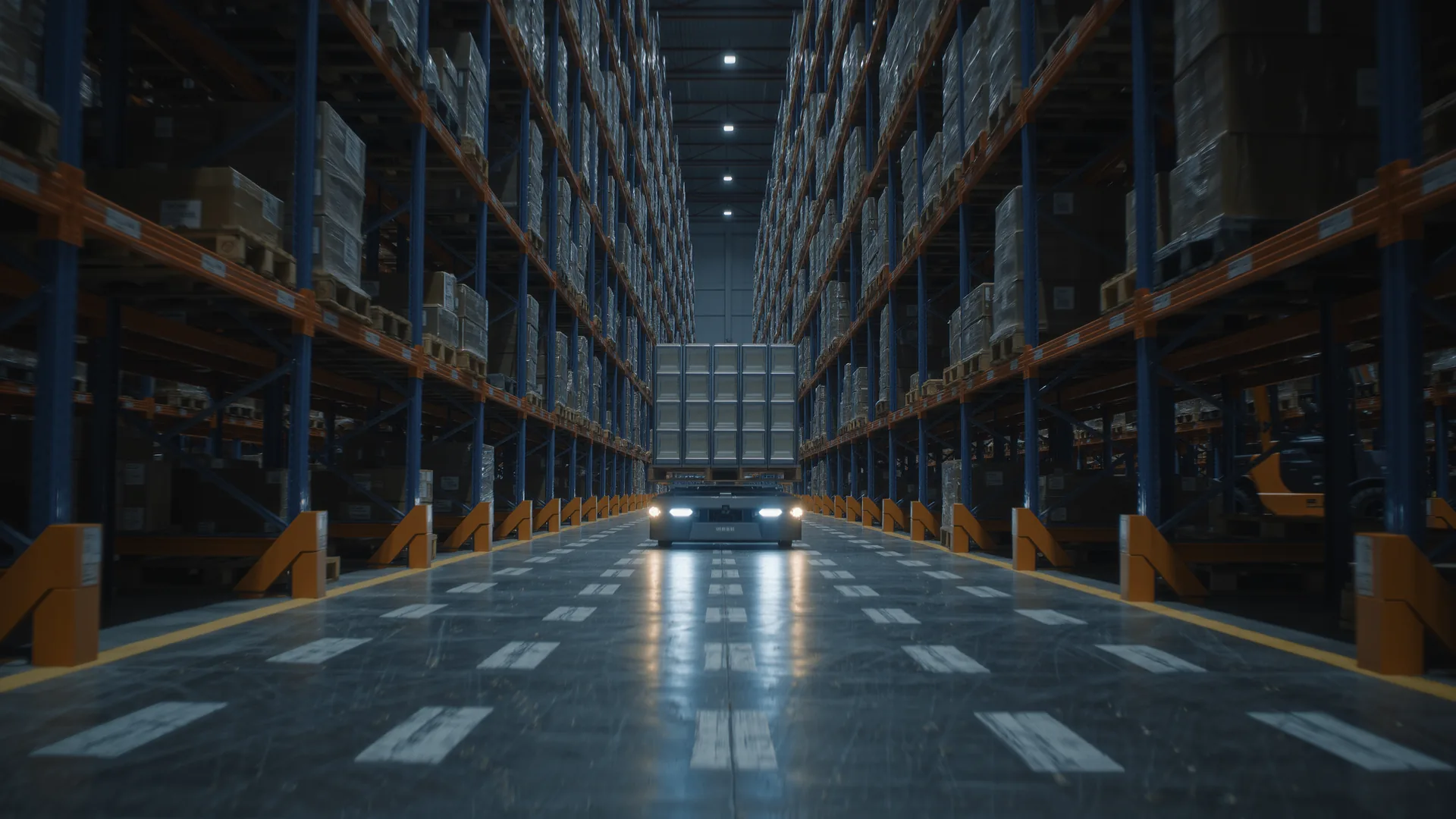
An AGV follows a fixed, installed path, whether that is magnetic tape, an inductive wire or reflector triangulation. An AMR carries a map and plans its own route, so it can drive around an obstacle instead of stopping at it. That one difference sets installation cost, changeover effort and, above all, what happens when a pallet is left in the aisle.
What actually differs
| Property | AGV | AMR |
|---|---|---|
| Path definition | Physically installed | Software map |
| Obstacle behaviour | Stops and waits | Re-plans and drives around |
| Floor infrastructure | Tape, wire or reflectors | None required |
| Route change effort | Physical work, hours to days | Map edit, minutes |
| Positional repeatability at a station | ±5 to ±15 mm | ±10 to ±50 mm, better with local features |
| Typical payload band | 100 to 5,000 kg | 50 to 1,500 kg |
| Behaviour in a congested aisle | Queues | Re-routes, if space allows |
| Best environment | Stable layout, heavy loads, high volume | Changing layout, mixed traffic |
The repeatability row deserves attention. A guided vehicle arriving on a wire is inherently well positioned, whereas a free-navigating robot arrives with more spread and usually needs a local feature, a marker or a mechanical funnel to dock precisely. Any handover to a conveyor or a robot arm needs that docking accuracy designed in.
Where the money goes
The vehicle price gap has narrowed to the point where it is rarely decisive. Infrastructure and change costs decide instead.
- Guide path installation runs roughly 20 to 80 euro per metre for tape or embedded wire, plus floor preparation. A 400 m circuit is therefore 8,000 to 32,000 euro before any vehicle arrives, and it has to be redone when the layout changes.
- Reflector-based navigation avoids floor work but needs surveyed reflectors, typically 3 visible from every point on the route. Surveying a 5,000 m² hall is a day or more of work and must be repeated when racking moves.
- AMR mapping is a drive-through of an hour or two, plus route and station definition. Re-mapping after a layout change is measured in hours, not days.
- Fleet software is a real line item for both, and it is the piece that scales badly if it is an afterthought. Traffic control, charging management and interfaces to the warehouse system commonly cost as much as two or three vehicles.
The safety frame is the same
Both types fall under ISO 3691-4 for driverless industrial trucks, and the requirements do not soften because the vehicle is clever. The vehicle needs safety-rated obstacle detection, a defined stopping performance, and speeds limited so it can stop within the detection field. The detection field itself must be sized dynamically: faster travel demands a longer field, and a robot that shortens its field to squeeze past a pallet is reducing its own stopping margin.
Practical consequence: the throughput advantage of free navigation is smaller than expected in tight aisles, because both vehicle types end up speed-limited by the same stopping distance arithmetic.
Choosing between them
- Is the layout stable for five years? If yes, and volumes are high on fixed routes, AGVs remain a strong, cheap and extremely reliable answer.
- Do people and forklifts share the aisles? Mixed traffic favours AMRs, because stopping for every obstruction destroys AGV throughput.
- Is the payload above 1,500 kg? Heavy transport is still largely AGV territory.
- How often does the process change? Seasonal reconfiguration, frequent new SKUs or a growing site all favour software-defined routes.
- Is docking accuracy critical? Precise handover to fixed equipment favours guided vehicles or AMRs with local docking features.
Hybrid fleets are common and sensible: guided vehicles on the high-volume trunk route, free-navigating robots for the variable last leg into production.
Frequently asked questions
What is the difference between an AGV and an AMR?
An AGV follows a physically installed guide path and stops when something blocks it. An AMR carries a map, localises itself and plans its own route, so it can drive around an obstruction. Everything else, including the applicable safety standard, is largely the same.
Is an AMR always better?
No. For stable layouts, heavy payloads and high-volume fixed routes, guided vehicles are cheaper, simpler and extremely reliable. AMRs earn their premium where the layout changes or where people and forklifts share the aisles.
Do AMRs need floor infrastructure?
No tape, wire or reflectors are required for navigation, though charging stations and sometimes local docking markers are. The cost moves from floor work to mapping, traffic rules and fleet software.
Which is more accurate at a pick station?
Guided vehicles typically dock within ±5 mm to ±15 mm because the path itself positions them. Free-navigating robots arrive with more spread and usually need a local feature, marker or mechanical funnel to reach comparable accuracy.
Does the same safety standard apply to both?
Yes. ISO 3691-4 covers driverless industrial trucks regardless of how they navigate, and both require safety-rated obstacle detection with fields sized to the stopping distance at the travelling speed.
Sources
- ISO 3691-4, industrial trucks, safety requirements for driverless trucks and their systemsInternational Organization for Standardization
- ISO 8373, robotics vocabularyInternational Organization for Standardization, definitions of mobile robot terms
- World Robotics, service robots report seriesInternational Federation of Robotics, logistics robot deployment volumes