Actuators and Mechanics
Vacuum, Two-Finger, Magnetic: Gripper Types Compared
Six gripper families, what each holds reliably, what defeats it, and the holding force arithmetic that decides the size before the type.
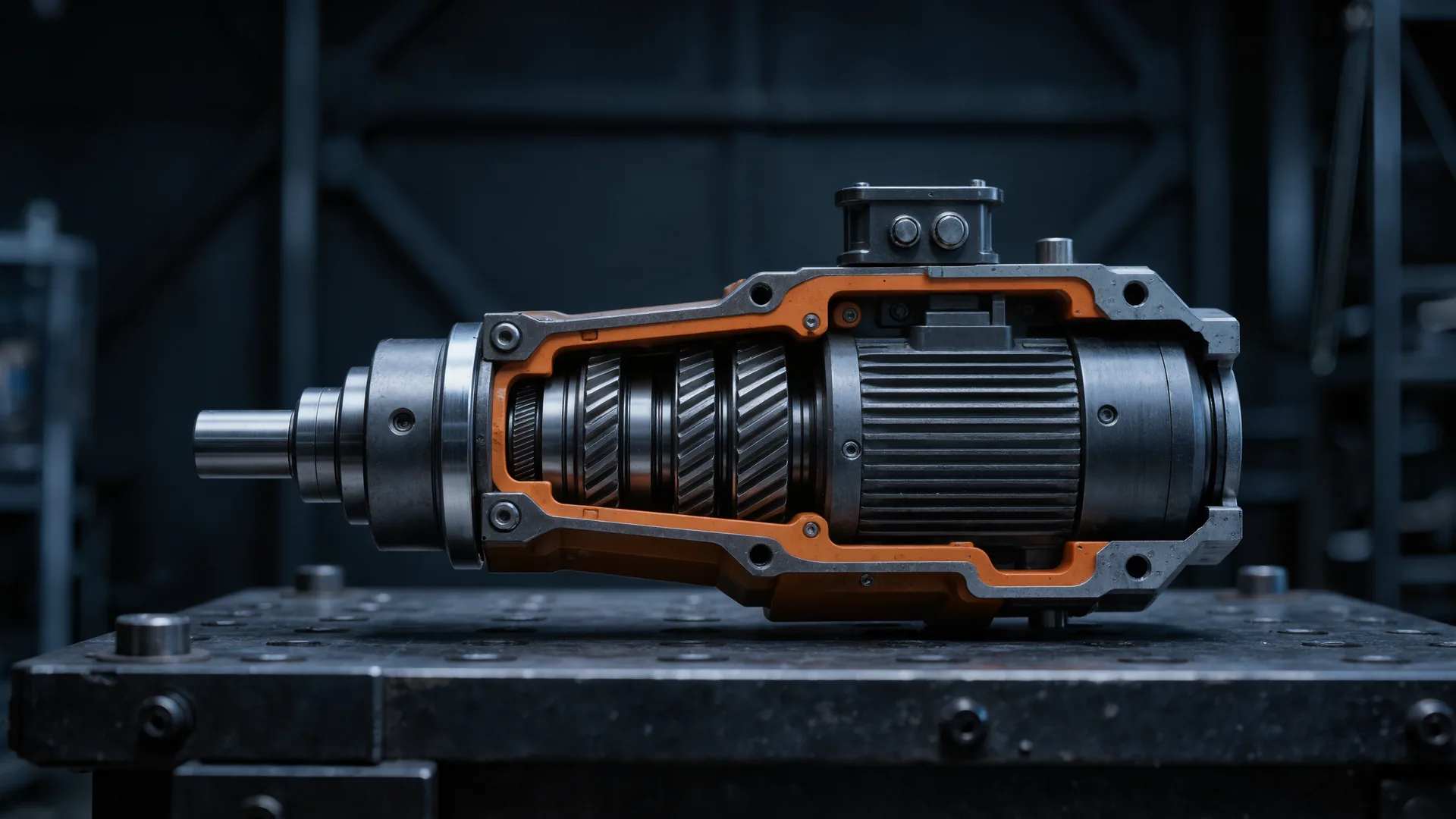
Match the gripper to the surface, not the part. Vacuum needs a smooth sealed area of a few square centimetres, magnets need ferrous material, and jaws need a graspable feature with clearance around it. Calculate the holding force first, because a 2 kg part at 5 m/s² acceleration with a friction coefficient of 0.2 needs about 170 N of clamping force, which rules out most compact grippers immediately.
The six families
| Type | Force | Cycle life | Holds | Defeated by |
|---|---|---|---|---|
| Vacuum cup | 10 to 600 N | very high | Flat sealed surfaces, cartons, sheets | Porous, textured, oily, perforated |
| Two-finger parallel | 20 to 1,200 N | 5 to 50 M | Almost anything with a graspable feature | No clearance, fragile surfaces |
| Three-finger centric | 30 to 800 N | 3 to 20 M | Round parts, self-centring | Flat and asymmetric parts |
| Adaptive underactuated | 5 to 200 N | 1 to 10 M | Irregular and varied shapes | Precision placement |
| Magnetic | 50 to 900 N | very high | Ferrous parts, oily surfaces, rough finish | Non-ferrous, residual magnetism, thin sheets sticking together |
| Soft and bellows | 2 to 60 N | 1 to 5 M | Food, fragile, deformable items | High force, precise positioning |
Vacuum, where most surprises live
Theoretical vacuum force is cup area times pressure differential. A 40 mm cup has about 12.6 cm² of area, and at a differential of 60 kPa that is roughly 75 N vertically. In practice expect 60 % to 80 % of that, and much less in these cases:
- Porous surfaces. Recycled corrugated board leaks continuously, so holding force depends on pump flow rather than on cup area.
- Cold or damp conditions. Condensation on cold-store cartons breaks the seal.
- Shear loading. A cup resists lateral force through friction only, typically a fraction of its vertical rating, so accelerating sideways drops parts that lift perfectly.
- Curved or ribbed surfaces. Bellows cups conform better than flat ones and give up some rigidity in exchange.
Gripper mass against robot payload
The gripper eats the payload before the part does, and the mass differs by a factor of four across types that could all perform the same task.
| Assembly | Gripper | Coupler | Cabling | Total |
|---|---|---|---|---|
| Single vacuum cup with ejector | 0.25 kg | 0.15 kg | 0.10 kg | 0.50 kg |
| Four-cup vacuum bar | 1.40 kg | 0.20 kg | 0.25 kg | 1.85 kg |
| Compact electric two-finger | 0.90 kg | 0.20 kg | 0.15 kg | 1.25 kg |
| Industrial electric two-finger | 1.90 kg | 0.30 kg | 0.20 kg | 2.40 kg |
| Dual gripper for machine tending | 3.20 kg | 0.40 kg | 0.30 kg | 3.90 kg |
| Magnetic head with release | 1.10 kg | 0.20 kg | 0.15 kg | 1.45 kg |
| Tool changer plus two-finger | 1.90 kg | 0.85 kg | 0.20 kg | 2.95 kg |
On a 10 kg-rated arm, a dual gripper at 3.9 kg leaves 6.1 kg before the derating for centre of gravity offset is applied. That is why the machine tending example so often ends up needing the next payload class.
A selection sequence
- Is the part ferrous and is residual magnetism acceptable? If yes, a magnet is usually the cheapest and most tolerant answer.
- Is there a flat sealed area of at least 2 to 3 cm²? If yes, and the load is mostly vertical, vacuum is fast and simple.
- Is there a feature to capture? If yes, form-fit jaws, and the force calculation becomes trivial.
- Does the part vary in shape? If yes, an adaptive gripper, accepting lower placement precision.
- Is the part fragile or deformable? If yes, soft or bellows grippers with force limiting.
- Only then calculate the required force, apply a safety factor of two to four, and check the gripper mass against the robot payload.
The collaborative constraint
On an arm operating with contact permitted, the gripper is usually what fails the assessment rather than the arm. Jaw closing is a quasi-static clamping scenario, so the limits are the lower set: 140 N of force and 260 N/cm² of pressure at the hand. A gripper closing at 400 N needs its pinch zone designed out, covered or made unreachable, regardless of how gentle the arm is.
Frequently asked questions
Which gripper type should I choose?
Work from the surface. Ferrous parts favour magnets, flat sealed surfaces favour vacuum, a capturable feature favours form-fit jaws, varied shapes favour adaptive grippers, and fragile items favour soft grippers.
How much vacuum force does a cup provide?
Area times pressure differential, so a 40 mm cup at 60 kPa gives roughly 75 N in theory and 60 % to 80 % of that in practice. Lateral force capacity is a fraction of the vertical figure because it relies on friction.
Why do vacuum grippers fail on recycled cardboard?
Because it is porous and leaks continuously, so holding force depends on pump flow rather than on cup area. Cold-store condensation compounds it by breaking the seal at the cup lip.
Why is form-fit better than friction?
It removes the friction coefficient from the calculation, which is the largest uncertainty in gripper sizing. It also usually allows a smaller, lighter and cheaper gripper for the same part.
What limits gripper force on a collaborative robot?
The quasi-static clamping limits, since a finger between closing jaws cannot retreat. That means 140 N of force and 260 N per square centimetre at the hand, so grippers closing harder need the pinch zone designed out or guarded.
Sources
- ISO/TS 15066:2016, Annex A quasi-static limitsForce and pressure limits applied to jaw closing zones
- ISO 10218-1:2025, Robotics, Safety requirements, Part 1International Organization for Standardization, end effector and power loss requirements
- ISO 8373, robotics vocabularyInternational Organization for Standardization, end effector terminology