Actuators and Mechanics
Torque Density: The Number That Limits Every Robot Arm
Torque per kilogram of joint decides how much a robot can carry and how fast it moves. Where the limit comes from, what the current numbers are, and what would move them.
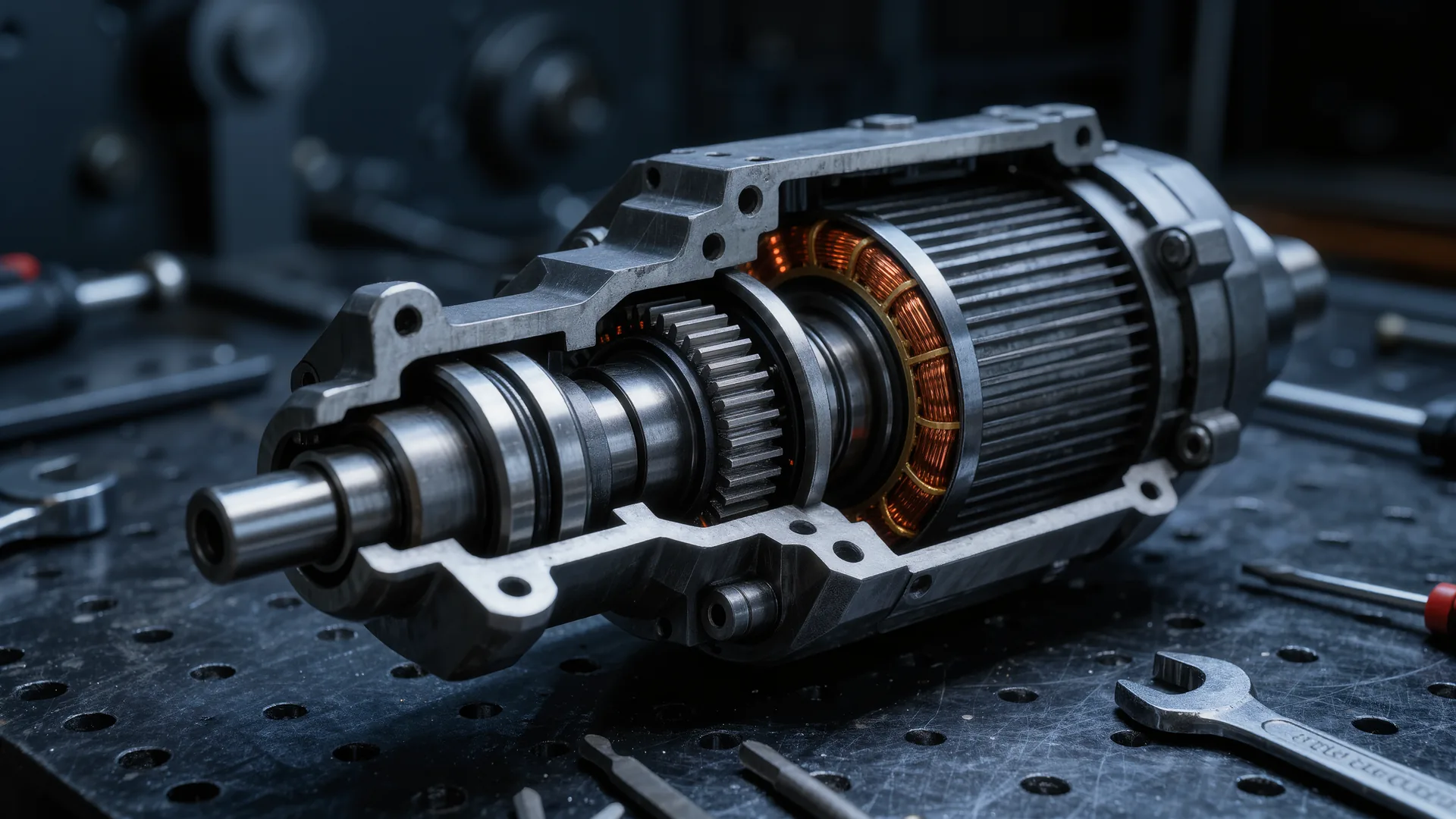
Torque density is torque divided by the mass producing it, and it governs everything downstream: payload, reach, acceleration and, on a legged machine, whether it can stand up. Complete robot joint modules currently reach roughly 10 to 60 Nm per kg, and the binding constraint is not the magnet or the gear but heat, because torque in an electric motor is current and current is loss.
Why heat is the limit
Motor torque is proportional to current, and resistive loss is proportional to current squared. Doubling torque therefore quadruples heating in the windings. A joint that delivers 40 Nm continuously might deliver 120 Nm for a few seconds, and the difference between those two numbers is entirely thermal.
This is why datasheets separate continuous from peak torque, and why a duty cycle matters more than a peak figure. A robot that hits peak torque briefly once per cycle behaves very differently from one that holds 80 % of peak continuously, even though both are within specification.
| Component | Share of module mass | Contributes torque |
|---|---|---|
| Gearbox | 30 to 45 % | Yes, multiplies it |
| Motor rotor and stator | 25 to 40 % | Yes, produces it |
| Housing and bearings | 15 to 25 % | No, carries loads |
| Encoder and electronics | 5 to 12 % | No |
| Brake | 4 to 10 % | No, holds only |
| Thermal management | 2 to 8 % | No, enables it |
What is achievable today
| Design | Continuous torque density | Bandwidth | Used in |
|---|---|---|---|
| Direct drive | 1 to 4 Nm/kg | very high | Precision positioning, some legged joints |
| Quasi-direct drive, 6:1 to 10:1 | 4 to 12 Nm/kg | high | Legged robots, dynamic manipulation |
| Harmonic drive joint | 15 to 40 Nm/kg | moderate | Cobots, industrial wrists |
| Cycloidal joint | 20 to 60 Nm/kg | moderate | Industrial shoulders and elbows |
| Hydraulic actuator | 50 to 200 Nm/kg | high | Heavy legged machines, construction |
The hydraulic row explains a historical pattern. Hydraulics have by far the best torque density, which is why early heavy legged robots used them, and they bring a pump, a reservoir, hoses, leaks and noise. Electric actuation won on everything except raw density.
The three ways to improve it
- Better cooling. Liquid cooling or a conductive path to the structure raises continuous torque without changing the motor. It is the most effective lever available and it adds plumbing, mass and a failure mode.
- Higher gear ratio. Multiplies torque directly, and costs bandwidth, backdrivability and efficiency. For an industrial arm this is usually right; for a legged robot that must absorb impacts it is usually wrong.
- Better magnets and winding design. Higher-grade magnets and denser windings improve the constant relating current to torque. Real gains, incremental in size, and sensitive to rare earth material supply.
What does not help is a larger motor alone. Torque scales roughly with rotor volume while mass scales with it too, so simply scaling up leaves density unchanged and worsens inertia.
Where it matters most
- Legged robots. Every joint carries every other joint's mass. Poor torque density compounds up the chain and is the reason humanoid payloads are modest.
- Long-reach arms. The shoulder must accelerate the entire arm, so density at the outboard joints determines what the inboard joint must be.
- Mobile manipulators. Arm mass reduces payload on the base and raises tipping risk.
- Collaborative arms. Lower moving mass directly raises the permissible contact speed, so torque density buys throughput as well as payload.
Frequently asked questions
What is torque density?
Torque divided by the mass of the assembly producing it, usually expressed in newton metres per kilogram for a complete joint module including motor, gearbox, encoder and housing.
Why is heat the limit rather than magnetic saturation?
Because torque is proportional to current and resistive loss is proportional to current squared. Doubling torque quadruples winding heating, so continuous torque is set by how much heat the joint can shed.
What torque density do robot joints reach?
Roughly 10 to 60 Nm per kg for geared industrial joints, 4 to 12 for quasi-direct drive designs used in legged robots, and 1 to 4 for pure direct drive. Hydraulic actuators exceed all of them at 50 to 200.
How can torque density be improved?
Better cooling, a higher gear ratio, or improved magnets and windings. Cooling is the most effective; higher ratios cost bandwidth and backdrivability; magnet improvements are incremental and depend on material supply.
Why does it matter for humanoids in particular?
Because every joint carries the mass of every joint above it in the chain, so a density shortfall compounds. That compounding is the direct reason humanoid payloads sit at 16 to 25 kg rather than higher.
Sources
- ROBOTS guideIEEE Spectrum, published mass and payload figures used for the density comparison
- arXiv robotics preprints, actuator design for legged robotsPrimary literature on quasi-direct drive and torque density
- ISO 8373, robotics vocabularyInternational Organization for Standardization, joint and actuator terminology