Actuators and Mechanics
Series Elastic Actuators: Compliance Built Into the Joint
Putting a spring between motor and load turns force control into position control and protects the gearbox from shock. What it costs in bandwidth, and where it belongs.
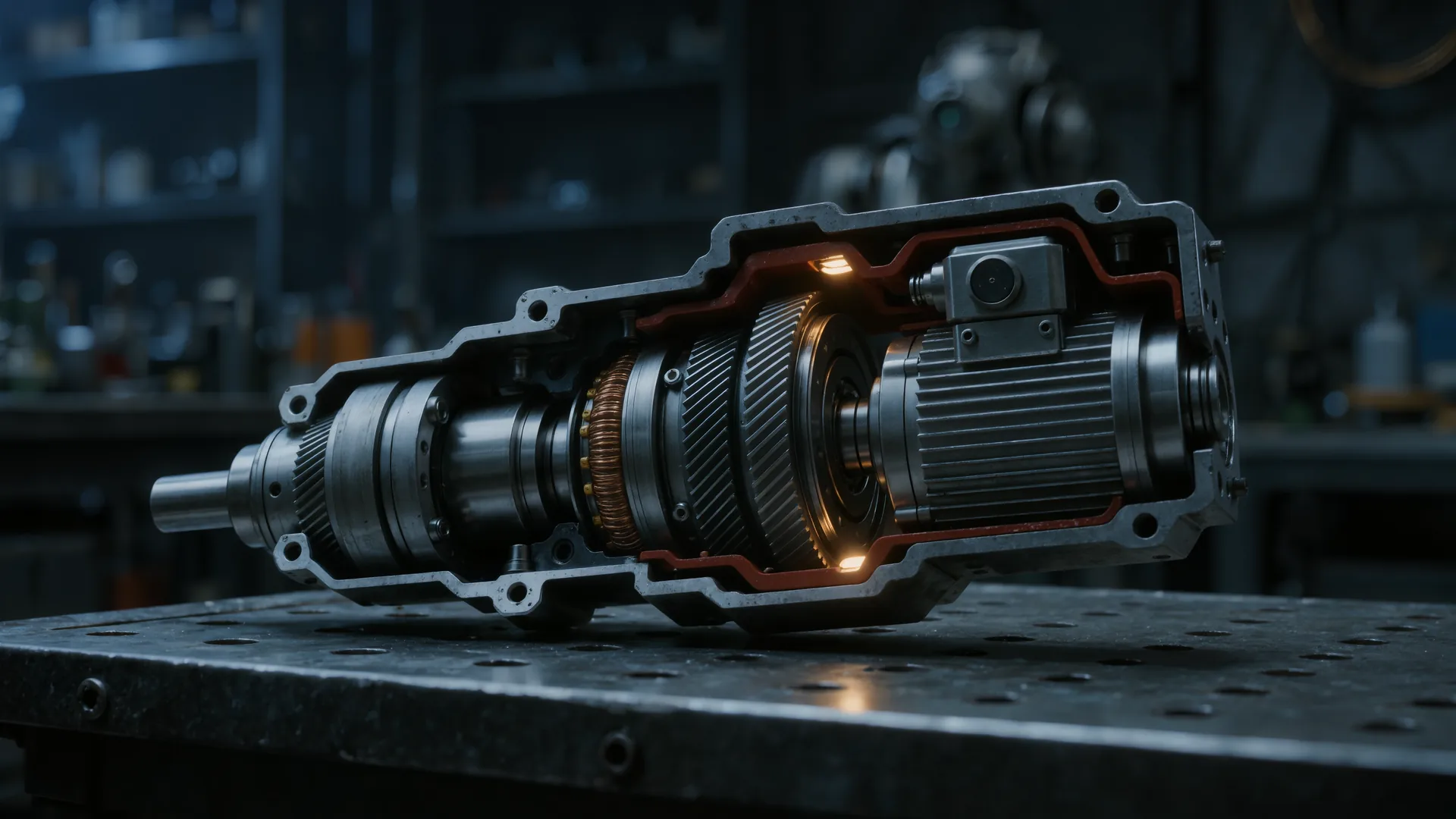
A series elastic actuator puts a deliberate spring between the gearbox output and the load. Measuring the spring's deflection gives an accurate force reading through Hooke's law, the compliance absorbs impact energy that would otherwise reach the gearbox teeth, and the whole thing turns a hard force control problem into an easier position control problem. The cost is bandwidth, typically limited to a few tens of hertz.
How it works
A conventional stiff actuator commands torque through a motor and gearbox and must measure force separately, usually with a strain gauge sensor whose deflection is deliberately tiny. A series elastic actuator instead places a compliant element in the drive train and measures its deflection with an encoder on each side. Force is then spring rate times deflection, a large and easily measured quantity rather than a microstrain.
| Property | Stiff actuator | Series elastic |
|---|---|---|
| Force measurement | Strain gauge sensor | Spring deflection, two encoders |
| Force resolution | good, noise limited | excellent, geometry limited |
| Force bandwidth | 100 to 1,000 Hz | 10 to 40 Hz |
| Position bandwidth | high | reduced |
| Shock tolerance | poor, load reaches the teeth | good, spring absorbs it |
| Energy storage | none | yes, can be returned |
| Positioning accuracy under load | high | reduced by spring deflection |
| Complexity | lower | higher, two encoders and a spring |
Choosing the spring rate
The spring rate sets everything, and the calculation is short. Force resolution is the encoder resolution multiplied by the spring rate; bandwidth falls as the spring softens.
| Spring rate | Deflection at 20 Nm | Force resolution | Approx. bandwidth |
|---|---|---|---|
| 100 Nm/rad | 11.5 deg | 0.005 Nm | 8 to 12 Hz |
| 250 Nm/rad | 4.6 deg | 0.012 Nm | 14 to 20 Hz |
| 500 Nm/rad | 2.3 deg | 0.024 Nm | 20 to 28 Hz |
| 1,000 Nm/rad | 1.15 deg | 0.048 Nm | 28 to 40 Hz |
| 2,000 Nm/rad | 0.57 deg | 0.096 Nm | 40 to 55 Hz |
Read the deflection column against the positioning requirement. At 100 Nm per radian the output sits 11.5 degrees behind the input under full load, which on a 0.5 m link is roughly 100 mm of tool displacement. That is why soft series elastic joints appear in legs and almost never in arms expected to place a part.
Where it belongs
- Legged robots. Foot impact at touchdown is an enormous transient. A spring absorbs it, protects the gearbox, and returns some energy on push-off.
- Rehabilitation and assistive devices. The device is attached to a person, so intrinsic compliance is a safety property rather than a control feature.
- Force-controlled manipulation where the required bandwidth is modest: polishing, sanding, surface following.
- Robots that interact with unmodelled environments, where a stiff actuator meeting an unexpected obstacle generates a torque spike the gearbox pays for.
Where it does not belong
- Precision positioning. The spring deflects under load, so the output position depends on the load. Compensation helps and does not eliminate it.
- High-bandwidth force control. Anything needing hundreds of hertz, such as fast insertion with contact transients, is outside its range.
- High stiffness tasks. Drilling, pressing, machining. The spring is the wrong feature entirely.
- Cost-sensitive designs. Two encoders, a spring element and the associated control add cost against a stiff joint with a simple current-based estimate.
Variants worth knowing
| Type | Compliance | Advantage | Cost |
|---|---|---|---|
| Series elastic | Fixed spring rate | Simple, accurate force measurement | moderate |
| Variable stiffness | Adjustable during operation | Stiff for precision, soft for impact | high |
| Parallel elastic | Spring alongside the actuator | Gravity compensation, energy saving | low |
| Quasi-direct drive | Low gear ratio, no spring | Backdrivable with high bandwidth | moderate |
| Active compliance | Software only | No hardware change | low, limited by bandwidth |
The last row is the competitor that has taken most of the ground. Many collaborative arms achieve compliant behaviour through joint torque sensing and fast control rather than through mechanical springs, which preserves positioning accuracy. Mechanical compliance retains a decisive advantage in one respect only: it works at the speed of physics, so it protects the gearbox during the milliseconds before any controller can react.
Frequently asked questions
What is a series elastic actuator?
An actuator with a deliberate spring between the gearbox output and the load. Measuring the spring deflection gives force directly through Hooke's law, and the compliance absorbs impact energy before it reaches the gear teeth.
Why does it limit bandwidth?
Because changing the output force requires deflecting the spring, so the actuator must physically move further than a stiff one would. Typical achievable force bandwidth is 10 Hz to 40 Hz against hundreds for a stiff joint.
Where is it used?
Legged robots, where foot impact would otherwise damage gearboxes, rehabilitation and assistive devices attached to people, and modest-bandwidth force control such as polishing and surface following.
Can software compliance replace it?
For most collaborative arms, yes, using joint torque sensing and fast control while keeping positioning accuracy. Mechanical compliance keeps one advantage: it acts at the speed of physics, protecting the gearbox in the milliseconds before any controller can respond.
What is variable stiffness actuation?
A design where the effective spring rate can be changed during operation, allowing a stiff configuration for precise positioning and a soft one for impact tolerance. It is more capable and considerably more complex and expensive.
Sources
- arXiv robotics preprints, compliant and series elastic actuationPrimary literature on design and bandwidth limits
- ISO 13482, safety requirements for personal care robotsInternational Organization for Standardization, intrinsic compliance as a safety measure
- ROBOTS guideIEEE Spectrum, actuator architectures across commercial legged and assistive robots