Industry and Economics
What an Industrial Robot Costs, and What the Robot Is Not
Arm prices by payload class, why the robot is a quarter of the cell, and the six line items that turn a 30,000 quotation into a 120,000 project.
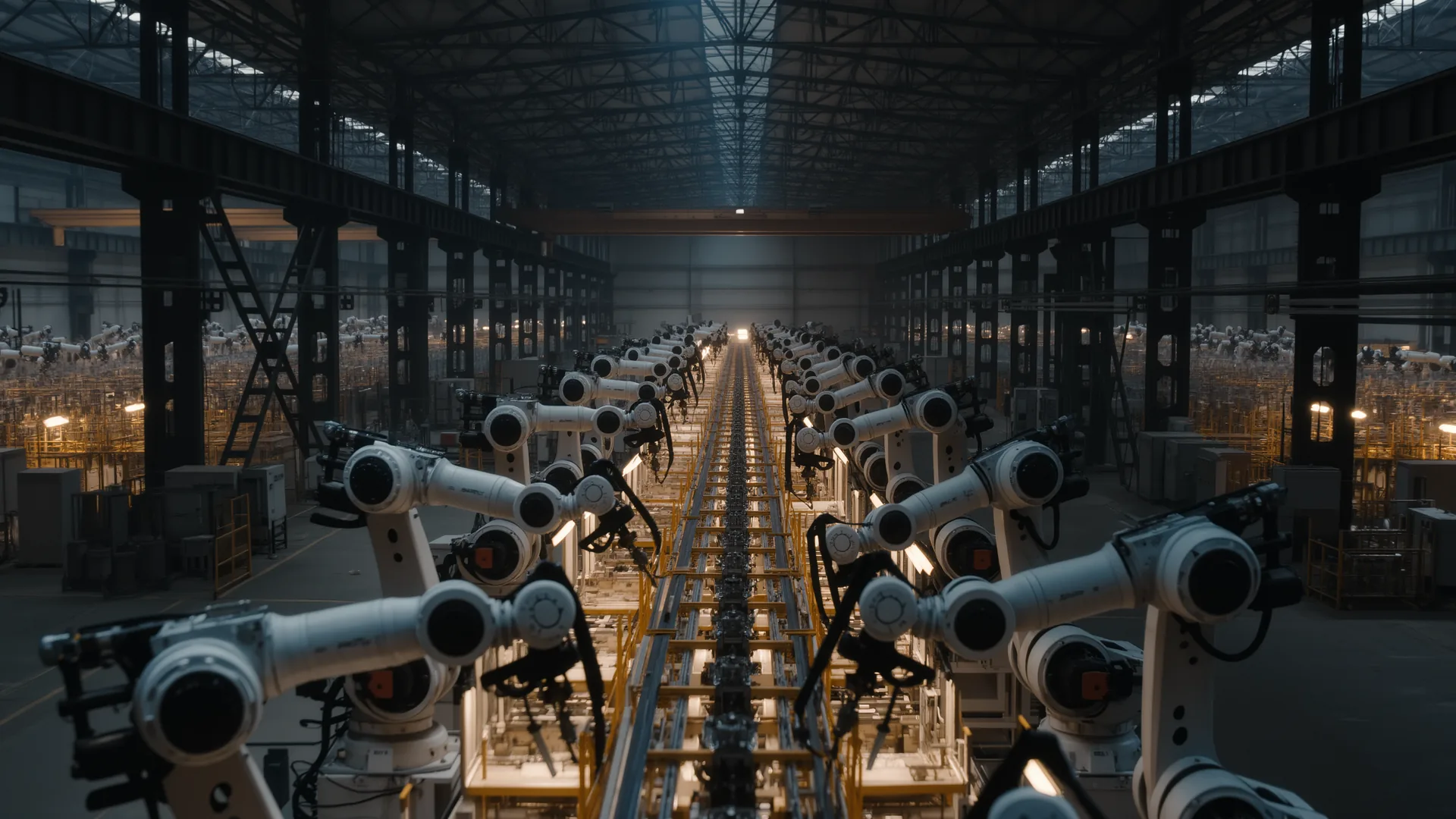
An industrial arm costs between roughly 20,000 and 90,000 euro depending on payload class, and that is 20 % to 35 % of a working cell. The reliable planning rule is three to four times the arm price for a single-station installation. A quotation showing the arm alone is not a quotation for automation, it is a quotation for a component.
Arm prices by class
| Payload | Reach | Price band | Typical application |
|---|---|---|---|
| 3 to 7 kg | 600 to 900 mm | 18,000 to 32,000 | Small part handling, assembly |
| 10 to 20 kg | 1,400 to 1,800 mm | 26,000 to 48,000 | General handling, arc welding |
| 50 to 80 kg | 2,000 to 2,300 mm | 42,000 to 70,000 | Machine tending, spot welding |
| 120 to 240 kg | 2,600 to 3,100 mm | 55,000 to 95,000 | Palletising, press tending |
| 500 to 1,000 kg | 3,100 to 4,700 mm | 95,000 to 180,000 | Body handling, foundry |
| Collaborative, 5 to 30 kg | 850 to 1,750 mm | 20,000 to 75,000 | Shared workspace tasks |
Bands are wide because list price is a weak indicator. Volume agreements, regional pricing, controller options, safety packages and software licences all move the figure, and a buyer purchasing twenty arms a year pays substantially less than one buying a single unit.
The rest of the cell
| Item | Share | Note |
|---|---|---|
| Robot arm and controller | 20 to 35 % | The visible part |
| End effector and tool changer | 5 to 15 % | Rises sharply with part variety |
| Part presentation and fixturing | 10 to 25 % | The item most often underestimated |
| Guarding and safety hardware | 5 to 12 % | Fence, scanners, interlocks |
| Vision and sensing | 0 to 18 % | Zero on many cells, large on bin picking |
| Integration engineering | 18 to 35 % | The largest single item on complex cells |
| Installation and commissioning | 6 to 14 % | Includes production downtime |
| Documentation and conformity | 4 to 10 % | Risk assessment, validation, CE file |
What actually moves the total
- Part variety. One part in one orientation is cheap. Twelve variants arriving at random orientations is a different project, and the difference lands in fixturing, vision and engineering rather than in the arm.
- Interfacing to existing equipment. A machine with a robot interface option costs a few thousand to connect. A machine from twenty years ago without one is a controls project.
- Required autonomy. A cell that runs unattended for eight hours needs magazines, stackers or drawers. A cell attended every twenty minutes does not, and saves little labour.
- Cycle time target. A relaxed target permits a smaller arm and simpler tooling; an aggressive one drives dual grippers, faster arms and more complex motion.
- Commissioning window. Weekend and shutdown work carries a premium and is usually cheaper than the production it protects.
Where the price is genuinely falling
Arm prices have declined in real terms over decades, driven by volume: 542,000 units were installed worldwide in 2024 against roughly half that a decade earlier. The parts of the cell that have not fallen are the human ones. Integration engineering, commissioning and documentation are labour, and labour has become more expensive rather than less.
The practical consequence is that the arm is a shrinking share of a project's cost, and the leverage available to a buyer sits in reducing engineering effort: standardising on one controller, reusing fixture designs, keeping part presentation consistent, and specifying cells that resemble the last one.
Frequently asked questions
How much does an industrial robot cost?
Roughly 18,000 to 32,000 euro for a small 3 to 7 kg arm, 26,000 to 48,000 for a 10 to 20 kg class, and 55,000 to 95,000 for a 120 to 240 kg palletising arm, each with controller and pendant.
What does a complete cell cost?
Three to four times the arm price for a single station. The robot is typically 20 % to 35 % of the total, with integration engineering, part presentation and tooling accounting for most of the rest.
Why do quotations differ so much for the same arm?
Controller options. Safe motion monitoring, fieldbus modules, vision interfaces and offline programming licences are often separate line items, so two quotations for the same model can differ by a five-figure sum.
What is most often underestimated?
Part presentation and fixturing, followed by the interface to existing machines. Both are invisible in a robot quotation and both scale with part variety rather than with robot specification.
Are robot prices falling?
Arm prices have fallen in real terms as volumes grew, with 542,000 units installed in 2024. The engineering, commissioning and documentation portions have not, so the arm is a shrinking share of the project cost.
Sources
- World Robotics 2025, industrial robotsInternational Federation of Robotics, installation volumes underlying the volume argument
- Regulation (EU) 2023/1230 on machineryEU-OSHA, conformity obligations driving the documentation line
- ISO 10218-1:2025, Robotics, Safety requirements, Part 1International Organization for Standardization, validation work included in the cell cost