Industry and Economics
The Robot Supply Chain: Where the Bottlenecks Are
Robot builders are assemblers. The constraints sit in precision gearboxes, absolute encoders and integration capacity, and only one of those three is a manufacturing problem.
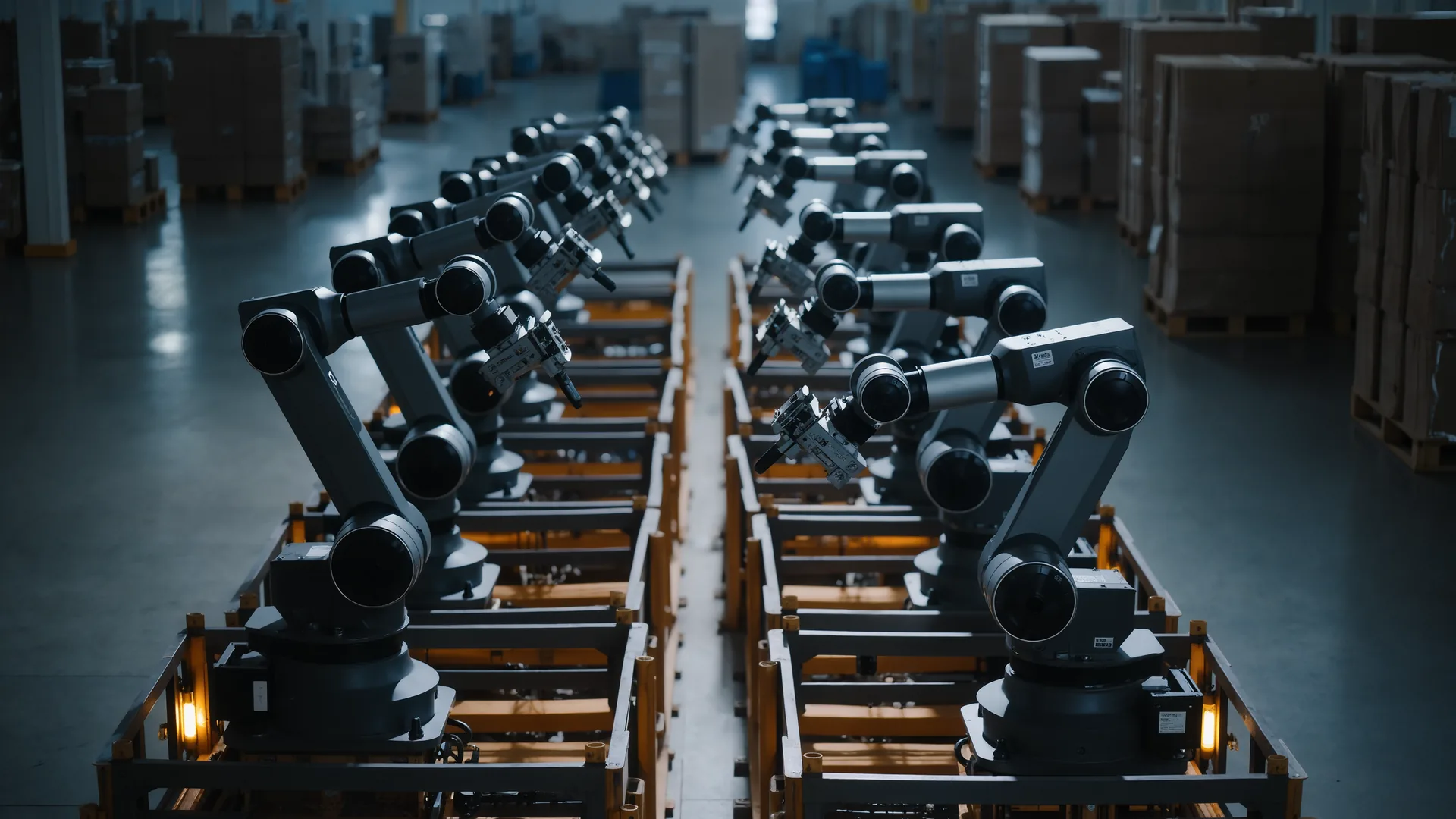
Three constraints govern robot output, and they are not the ones buyers expect. Precision gearboxes come from a very small group of specialists and are the tightest layer. Absolute encoders are the second. The third is not a component at all: integration capacity, which is what actually limits how fast robots reach production, since arms sit in crates while an integrator is unavailable.
The layers of the chain
| Layer | Supplier concentration | Lead time sensitivity | Note |
|---|---|---|---|
| Precision reducers | very high | very high | Cycloidal and harmonic, few specialists |
| Absolute encoders | high | high | 17 to 23 bit multi-turn devices |
| Servo motors and drives | moderate | moderate | Several builders make their own |
| Power semiconductors | moderate | episodic | Shared with the wider electronics market |
| Castings and structure | low | low | Widely available foundry capacity |
| Controllers and software | proprietary | low | In-house at every major builder |
| End effectors and sensing | very low | low | Large competitive supplier base |
| Integration engineering | fragmented | very high | The real deployment constraint |
Why gearboxes are the tight layer
A six-axis robot needs six precision reducers, so 542,000 robots installed in 2024 implies on the order of three million units of demand, plus spares. These are hard parts: sub-arcminute backlash, thousands of hours of rated life under shock loading, and a hollow shaft for cable routing. The manufacturing know-how is deep, capital intensive and slow to replicate, which is why the supplier base has stayed narrow for decades and has been concentrated in Japan.
The strategic response has been visible for several years. Several robot builders have invested in their own reducer capacity, and Chinese manufacturers in particular treated it as a prerequisite for scale. Domestic Chinese suppliers reaching 57 % of their home market in 2024, against roughly 28 % as a decade average, is not a pricing story alone; it required solving the gearbox problem.
Lead times across the chain
Planning a deployment means adding these up, in the right order, rather than quoting the longest one.
| Item | Good conditions | Constrained conditions |
|---|---|---|
| Standard industrial arm | 4 to 8 weeks | 20 to 40 weeks |
| Collaborative arm | 2 to 6 weeks | 10 to 20 weeks |
| Precision reducer as a spare | 6 to 12 weeks | 26 to 52 weeks |
| Absolute encoder as a spare | 4 to 10 weeks | 16 to 30 weeks |
| Safety controller and scanners | 3 to 8 weeks | 12 to 26 weeks |
| Custom fixturing | 4 to 10 weeks | 8 to 16 weeks |
| Integrator engineering slot | 6 to 12 weeks | 20 to 40 weeks |
| Commissioning window on your line | as scheduled | next shutdown |
The two longest rows in the constrained column are a reducer spare at up to 52 weeks and an integrator slot at up to 40. Neither is a robot, and both decide whether a project runs.
Managing the risk as a buyer
- Ask for a written delivery date rather than a lead time range, and ask what it depends on.
- Order spares with the machine. A spare gearbox for a critical axis costs a fraction of the downtime it prevents, and spares are subject to the same constraint as new production.
- Standardise on fewer robot models so a spare covers several machines rather than one.
- Book integration capacity early. Integrator availability is the constraint most often discovered last, and it is usually the one that moves the go-live date.
- Separate the arm order from the cell order where lead times differ, so the crate arrives when the fixtures do rather than months earlier.
The regional dimension
Component concentration has geopolitical consequences that buyers now price. A robot built in one region using reducers from another and semiconductors from a third is exposed to trade policy at three points, and several large manufacturers have responded by regionalising assembly even where components remain concentrated.
For a buyer, the practical question is narrower: where are the spare parts, and how long does a replacement gearbox actually take to arrive. A regional distribution centre with stock is worth more in a breakdown than any statement about where the machine was assembled.
Frequently asked questions
What limits robot production?
Precision gearboxes above all, followed by absolute encoders. Both come from a narrow supplier base with deep manufacturing know-how, and both are needed six times over in every six-axis arm.
Why are precision reducers so concentrated?
Because they demand sub-arcminute backlash, long life under shock loading and a hollow shaft for cabling, all at volume. The know-how is capital intensive and slow to replicate, so the supplier base has remained narrow for decades.
What is the real deployment constraint?
Integration capacity. Arms are frequently available faster than integrators, so robots wait in crates while engineering resource is scheduled. This constraint is rarely discussed as a supply chain issue and it governs go-live dates.
Should I hold spare parts?
Yes for critical axes. A spare gearbox costs a fraction of the downtime it prevents, and spares are drawn from the same constrained supply as new production, so a breakdown is exactly when it is hardest to get one.
Does regional assembly reduce risk?
Partly. It shortens final delivery and helps with trade exposure, and it does not change component concentration. The more useful question for a buyer is where spare parts are stocked and how quickly they can arrive.
Sources
- World Robotics 2025, industrial robotsInternational Federation of Robotics, installation volumes and Chinese domestic supplier share
- Robot density surges in Europe, Asia and the AmericasInternational Federation of Robotics, regional demand context
- World Robotics report seriesInternational Federation of Robotics, methodology and historical series