Safety and Standards
Stop Categories 0, 1 and 2: What Each One Does
Three stop categories, three different behaviours on a robot. Which to use where, why category 1 usually wins on an arm, and the common confusion with performance levels.
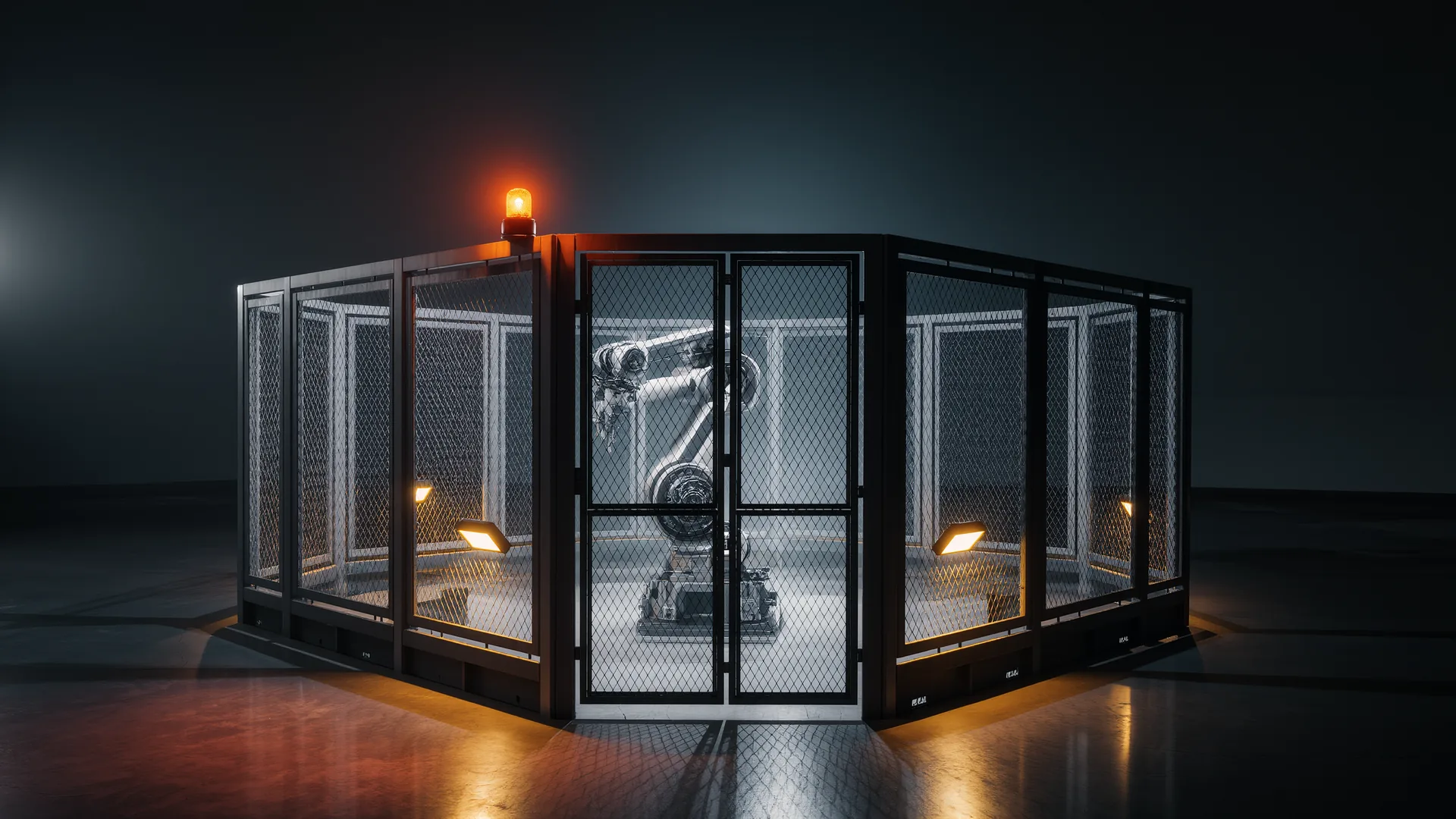
Category 0 removes drive power immediately and the arm coasts to a halt. Category 1 decelerates under control, then removes power. Category 2 stops the motion and keeps power on, holding position. On an articulated arm carrying a load, category 0 is frequently the worse safety outcome, because an uncontrolled arm can travel further and in an unpredictable direction than one that brakes deliberately.
The three categories
| Category | Behaviour | Power after stop | Robot consequence |
|---|---|---|---|
| 0 | Immediate removal of drive power | Removed | Coasts, brakes engage, unpredictable path |
| 1 | Controlled deceleration, then power removed | Removed after standstill | Shortest predictable stop, then safe state |
| 2 | Controlled stop, power maintained | Maintained | Holds position, fast restart |
Which category for which function
| Function | Category | Reason |
|---|---|---|
| Emergency stop button | 1 | Controlled stop, then a verified de-energised state |
| Safety fence door opened | 1 or 2 | 2 where fast restart matters and holding is safe |
| Safety scanner field entered | 2 | Safety-rated monitored stop, restart without rehoming |
| Collaborative operation, person present | 2 | Position held with drives energised |
| Electrical fault or contactor failure | 0 | Power removal is the required response |
| Maintenance isolation | 0 | Energy isolation for work on the machine |
Category 2 is what makes modern collaborative and shared cells practical. The robot stops with drives energised and resumes immediately when the person leaves, with no rehoming and no restart sequence. Achieving it requires a safety-rated standstill monitoring function, because the drives remain capable of motion.
How stopping distance differs by category
The numbers below are illustrative for a mid-size arm and show why the category choice feeds directly into the safety distance calculation.
| Speed | Category 0, coasting | Category 1, controlled | Difference |
|---|---|---|---|
| 250 mm/s | 60 to 120 mm | 30 to 60 mm | about 2x |
| 1,000 mm/s | 280 to 520 mm | 130 to 240 mm | about 2x |
| 2,000 mm/s | 700 to 1,300 mm | 300 to 560 mm | 2 to 2.5x |
| 3,000 mm/s | 1,300 to 2,400 mm | 520 to 950 mm | 2 to 2.5x |
Doubling the stopping distance doubles that term in the safety distance calculation, which in a compact cell can be the difference between a workable layout and one that does not fit. Actual figures must be measured on the specific arm at the programmed speed and payload, since the spread across models is wide.
The confusion worth clearing up
Stop category and performance level are unrelated scales, and mixing them is common. The category describes what the stop does, and it comes from IEC 60204-1. The performance level or SIL describes how reliably the function performs, and it comes from ISO 13849-1 or IEC 62061. A stop can be category 1 at PL c or category 1 at PL e, and those are very different functions.
A complete specification therefore states both, for each function: for example, protective stop, category 2, PL d.
Practical points
- Measure the stopping distance for each category at the actual speed and payload. It feeds directly into safety distance calculations and it differs substantially between categories.
- Remember the payload. A category 0 stop with a heavy part can shift the load in the gripper or drop it, which is a hazard the stop itself created.
- Check restart behaviour. After a category 0 stop some robots require rehoming, which is a downtime cost on every activation.
- Emergency stop must not create a new hazard. If removing power drops a suspended load or releases a clamp, the design has to address it.
- Stopping distance grows with wear. Re-measure periodically, since brake and gearbox condition change it over years.
Frequently asked questions
What is the difference between stop category 0, 1 and 2?
Category 0 removes drive power immediately and the machine coasts. Category 1 decelerates under control then removes power. Category 2 stops the motion and keeps power on, holding position.
Which category should an emergency stop use on a robot?
Category 1 in most cases. It brakes the arm actively for the shortest predictable stop and then removes power for a verified safe state, which category 0 cannot do because an unpowered arm coasts.
Why is category 2 used with safety scanners?
Because it holds position with drives energised, so the robot resumes immediately when the person leaves, without rehoming or a restart sequence. It requires a safety-rated standstill monitoring function.
Is category 0 the safest option?
Not necessarily. Removing power from a moving arm means momentum carries the load along an unpredictable path until brakes arrest it, and it can also shift or drop a held part. Controlled deceleration usually stops shorter and more predictably.
How do stop categories relate to performance levels?
They are unrelated. The category describes what the stop does, from IEC 60204-1. The performance level or SIL describes how reliably it performs, from ISO 13849-1 or IEC 62061. Specify both for each function.
Sources
- IEC 60204-1, safety of machinery, electrical equipment of machinesInternational Electrotechnical Commission, definition of stop categories 0, 1 and 2
- ISO 10218-1:2025, Robotics, Safety requirements, Part 1International Organization for Standardization, stop function requirements for robots
- ISO 13849-1, safety-related parts of control systemsInternational Organization for Standardization, performance levels for stop functions