Safety and Standards
ISO 10218:2025: What Changed for Robot Cells
The first full revision since 2011 folded ISO/TS 15066 into the standard, introduced two robot classes, added cybersecurity and moved the scope from robot system to robot application.
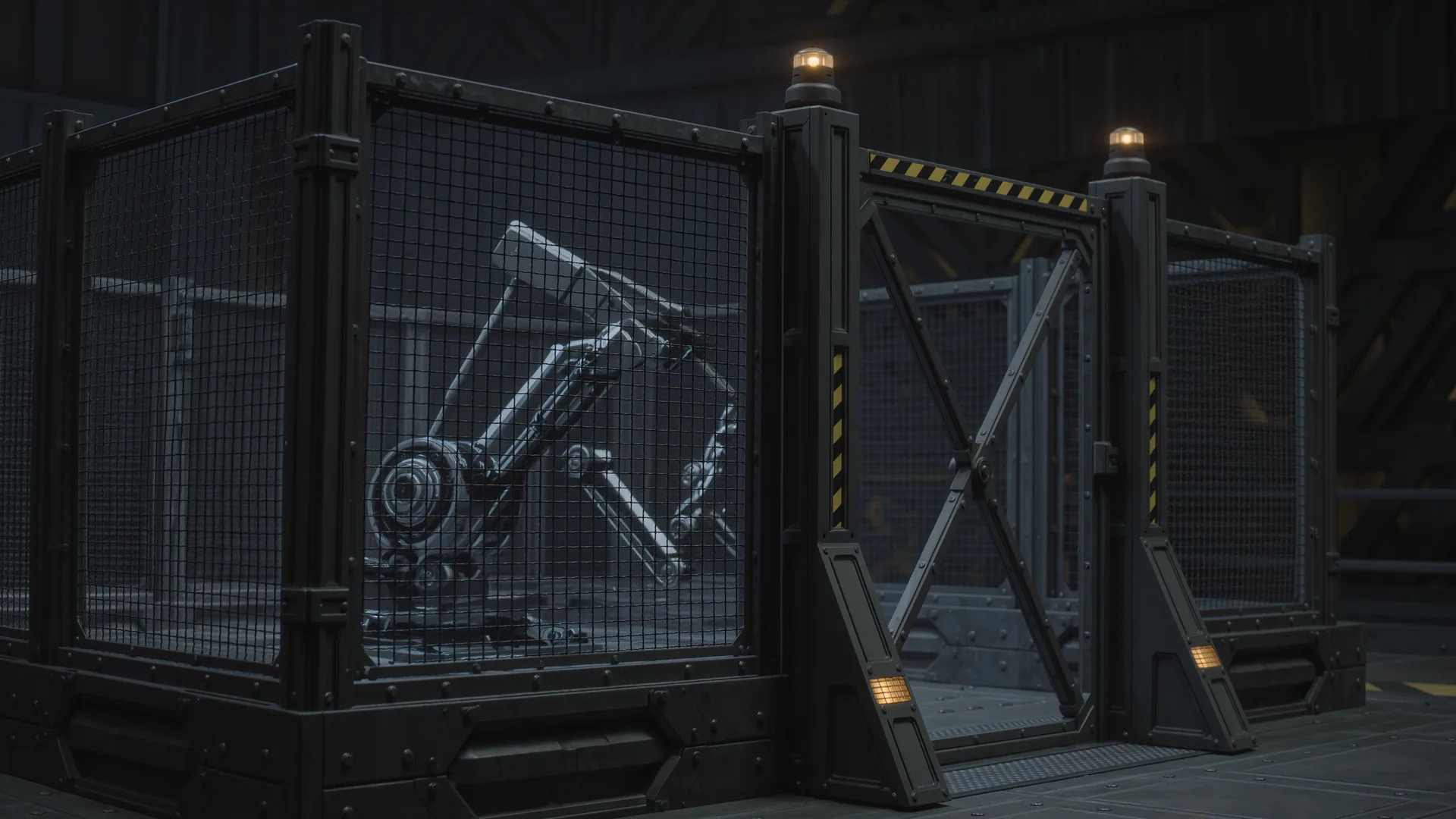
Both parts of ISO 10218 were published in February 2025, the first full revision since 2011. Four changes matter in practice: the content of ISO/TS 15066 moved into ISO 10218-2 and the technical specification no longer stands alone, ISO 10218-1 now defines two robot classes, cybersecurity requirements were added, and the scope shifted from robot system to robot application.
The four changes
| Change | Before | After |
|---|---|---|
| Collaborative requirements | ISO/TS 15066:2016, a separate technical specification | Folded into ISO 10218-2:2025 |
| Robot classification | One category of industrial robot | Class I for robots unable to cause significant harm, Class II for the rest |
| Cybersecurity | Not addressed | Requirements added, referencing industrial security practice |
| Scope of assessment | Robot system | Robot application, including workpiece, task program and support equipment |
| Functional safety | Present but less explicit | Clarified requirements and terminology |
The two classes
Class I covers robots that cannot cause significant harm by virtue of their design, such as very small, low-force machines. Class II covers everything else. The distinction is intended to avoid applying the full weight of the standard to machines whose hazard potential does not warrant it, which had become an obstacle for the smallest arms.
Practical consequence for a buyer: ask which class a robot is declared as, and read the constraints attached to a Class I declaration. A machine that qualifies only within a defined speed and payload envelope carries an implicit configuration limit that has to survive into your application.
What happened to ISO/TS 15066
Its content moved, its status ended. The biomechanical limits, the four collaborative operation types and the power and force limiting requirements are now inside ISO 10218-2:2025. The Annex A limit values were not weakened, so the force and pressure figures practitioners have used since 2016 remain the applicable ones.
Three consequences follow for existing documentation:
- References need updating. A risk assessment citing ISO/TS 15066 as the applicable document is citing something that no longer exists in that form.
- The numbers do not change, so measurement reports based on those limits remain technically valid.
- Suppliers claiming TS 15066 compliance are describing the same limits under an obsolete name, which is not wrong but should be clarified in a specification.
Where it sits in the standards family
ISO 10218 does not stand alone. A robot cell file references a stack of standards, and knowing which does what prevents both gaps and duplicated effort.
| Standard | Covers | Type |
|---|---|---|
| ISO 12100 | Risk assessment method for all machinery | Type A, general |
| ISO 13849-1 | Performance levels for safety-related control | Type B, generic safety aspect |
| ISO 13855 | Positioning of safeguards, approach speeds | Type B |
| ISO 13857 | Safety distances to prevent reaching hazard zones | Type B |
| ISO 10218-1:2025 | The robot itself | Type C, machine specific |
| ISO 10218-2:2025 | The robot application, including collaborative operation | Type C |
| ISO 3691-4 | Driverless trucks, where a mobile base is involved | Type C |
| IEC 62443 | Industrial cybersecurity | Supporting |
A type C standard takes precedence over type A and B where it addresses the same hazard, so ISO 10218 governs robot-specific questions while the more general documents fill the rest. That precedence is worth stating in the file, because it explains why a general requirement was handled a particular way.
What to do about it
| Situation | Action | Urgency |
|---|---|---|
| Cell in service, unchanged | No retrofit obligation from a standard revision alone | low |
| Cell being modified | Assess the modification against the current standard | medium |
| New cell being designed | Design and document to the 2025 revision | high |
| Cell for EU market delivery in 2027 | Assess against Regulation (EU) 2023/1230 as well | high |
| Templates and risk assessment forms | Update references, add cybersecurity and application scope | medium |
| Supplier specifications | Require declaration against the 2025 parts | medium |
The first row deserves emphasis because it is frequently misunderstood. A new edition of a standard does not by itself create an obligation to modify machinery already placed on the market. It becomes relevant when the machine is modified, when new machinery is placed on the market, or when a regulator or customer requires the current state of the art.
Frequently asked questions
When was ISO 10218 revised?
Both ISO 10218-1 and ISO 10218-2 were published in February 2025, the first full revision since the 2011 editions.
Does ISO/TS 15066 still exist?
Not as a standalone technical specification. Its power and force limiting content and biomechanical limits moved into ISO 10218-2:2025, and the limit values themselves were carried over unchanged.
What are the two robot classes?
Class I for robots that by design cannot cause significant harm, and Class II for all others. The split avoids imposing the full requirements on machines whose hazard potential does not warrant them.
Do I have to retrofit existing cells?
Not because of the revision alone. A new edition of a standard does not create a retrofit obligation for machinery already placed on the market, though it becomes relevant when the machine is modified or when a customer requires current practice.
What does the scope change to robot application mean?
The assessment now covers the workpiece, the task program and the supporting equipment, not just the robot and its guarding. Files that documented only the machine are incomplete under the new scope.
Sources
- ISO 10218-1:2025, Robotics, Safety requirements, Part 1: Industrial robotsInternational Organization for Standardization, published February 2025
- Updated ISO 10218: answers to frequently asked questionsAssociation for Advancing Automation, on robot classes, cybersecurity and the ISO/TS 15066 merger
- Regulation (EU) 2023/1230 on machineryEU-OSHA legislation record, the legal frame the standard supports