Field and Service Robotics
Weeding Robots: The Cost per Hectare That Decides It
A weeding robot competes with herbicide at a few euro per hectare and with hand labour at several hundred. Which one it faces determines whether the machine makes sense.
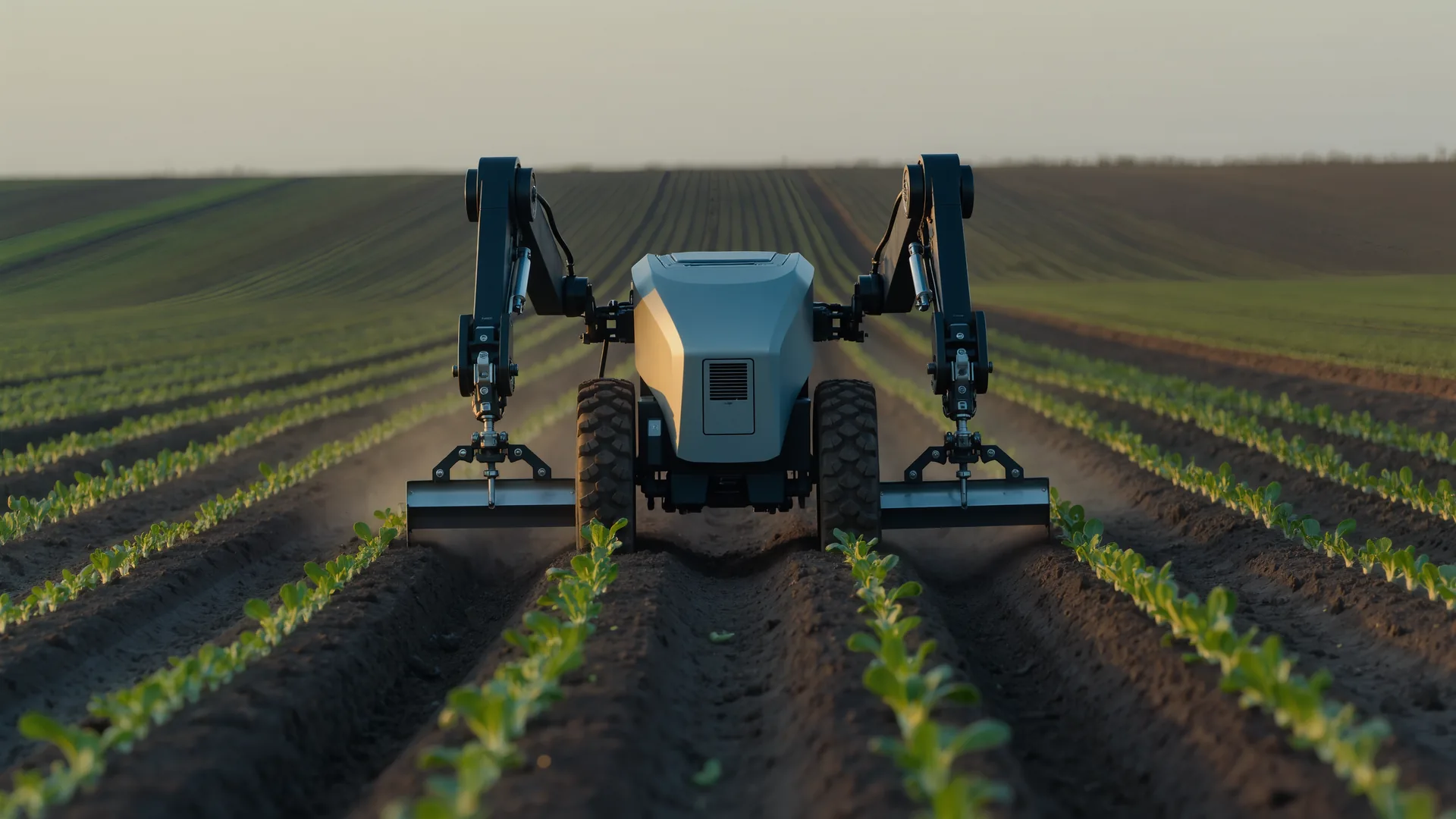
Weeding robots do not compete with one thing, they compete with two, and the gap between them is enormous. Chemical weeding costs roughly 30 to 120 euro per hectare per pass. Hand weeding in a high-value vegetable crop costs 300 to 1,200 euro per hectare per pass. A robot at 150,000 to 400,000 euro covering 0.3 to 1.5 hectares per hour loses badly against the first and wins comfortably against the second.
The cost per hectare
| Method | Cost | Speed | Constraint |
|---|---|---|---|
| Broadcast herbicide, tractor | 30 to 120 | 4 to 12 ha/h | Resistance, regulation, organic exclusion |
| Mechanical hoe, tractor mounted | 40 to 110 | 2 to 6 ha/h | Cannot work within the row |
| Camera-guided precision hoe | 60 to 180 | 1.5 to 4 ha/h | Needs a driver, works in-row partially |
| Autonomous weeding robot, mechanical | 120 to 400 | 0.3 to 1.5 ha/h | Capital, supervision, throughput |
| Autonomous weeding robot, laser or spot spray | 180 to 600 | 0.2 to 1.0 ha/h | Capital, power, throughput |
| Hand weeding | 300 to 1,200 | 0.02 to 0.1 ha/h | Labour availability, cost, backs |
Where the robot wins
- Organic production. Herbicide is not an option, so the comparison is directly against hand labour at 300 to 1,200 euro per hectare. This is the strongest case by a wide margin.
- High-value row vegetables. Lettuce, onions, carrots, brassicas. Close spacing, in-row weeds that a tractor hoe cannot reach, and crop value that tolerates a higher weeding cost.
- Herbicide resistance. Where chemistry has stopped working on a specific weed, the effective cost of the chemical pass is not 60 euro, it is 60 euro plus a failed crop.
- Regulatory loss of an active substance. Withdrawals move the comparison overnight, and a farm that has lost its residual herbicide is in the organic case whether it wanted to be or not.
- No labour at any price. Seasonal hand-weeding crews have become unavailable in several markets, which turns a cost comparison into an availability question.
Where it fails
- Broadacre cereals. At 30 to 120 euro per hectare for a chemical pass over hundreds of hectares in hours, no autonomous machine at current throughput comes close.
- Short weeding windows. Coverage of 0.3 to 1.5 hectares per hour against a three-day window sets a hard ceiling on farm size per machine.
- Wet ground. A light robot loses traction where a tractor still works, and the weeding window is often exactly when the ground is wettest.
- Crop and weed that look alike. Discrimination accuracy falls sharply when the weed is a grass in a grass-like crop, and a machine that removes crop is worse than no machine.
- Supervision cost. Few of these machines are genuinely unattended. If someone must remain within sight, a large part of the labour saving disappears.
A sizing model that survives the season
| Input | Conservative | Optimistic |
|---|---|---|
| Working rate | 0.5 ha/h | 1.2 ha/h |
| Working hours per day | 10 | 20 |
| Usable days in the window | 4 | 7 |
| Hectares per pass window | 20 | 168 |
| Passes per season | 3 | 3 |
| Weather and fault allowance | -30 % | -15 % |
| Serviceable area | 14 ha | 143 ha |
A tenfold spread from the same machine. The optimistic column assumes genuine unattended night running and a long window; the conservative one assumes supervised daytime work in a tight window. Which column applies is a question about the farm, not about the robot, and it should be settled before the order.
Frequently asked questions
Is a weeding robot cheaper than herbicide?
No. A chemical pass costs roughly 30 to 120 euro per hectare against 120 to 600 for an autonomous robot. The robot competes with hand weeding at 300 to 1,200 euro per hectare, which is where it wins.
Which crops justify one?
Organic production of any kind, and high-value row vegetables such as lettuce, onions, carrots and brassicas where in-row weeds cannot be reached by a tractor hoe and crop value tolerates the cost.
How much ground can one robot cover?
Between about 14 and 143 hectares per season depending on working rate, whether it runs unattended at night, and how wide the weeding window is. That tenfold spread is a property of the farm rather than the machine.
What is the biggest technical limitation?
Throughput, at 0.3 to 1.5 hectares per hour, followed by discrimination accuracy when the weed resembles the crop. Wet ground is the third, because light machines lose traction exactly when weeding matters most.
Do they run unattended?
Rarely in full. Most deployments keep a person within reach for fault clearing and field transfers, and that supervision consumes a substantial part of the labour saving the machine was bought for.
Sources
- World Robotics 2025 report, service robotsInternational Federation of Robotics, agriculture as a service robot segment
- Robotics at NISTNational Institute of Standards and Technology, robot performance measurement
- ISO 3691-4, safety requirements for driverless industrial trucksInternational Organization for Standardization, the nearest framework for autonomous ground vehicles