Field and Service Robotics
Cleaning Robots: The Cost per Square Metre
A commercial scrubber robot costs 25,000 to 60,000 euro and cleans 1,000 to 2,500 square metres an hour. Whether it saves money depends on one number: how much of the job it can actually take.
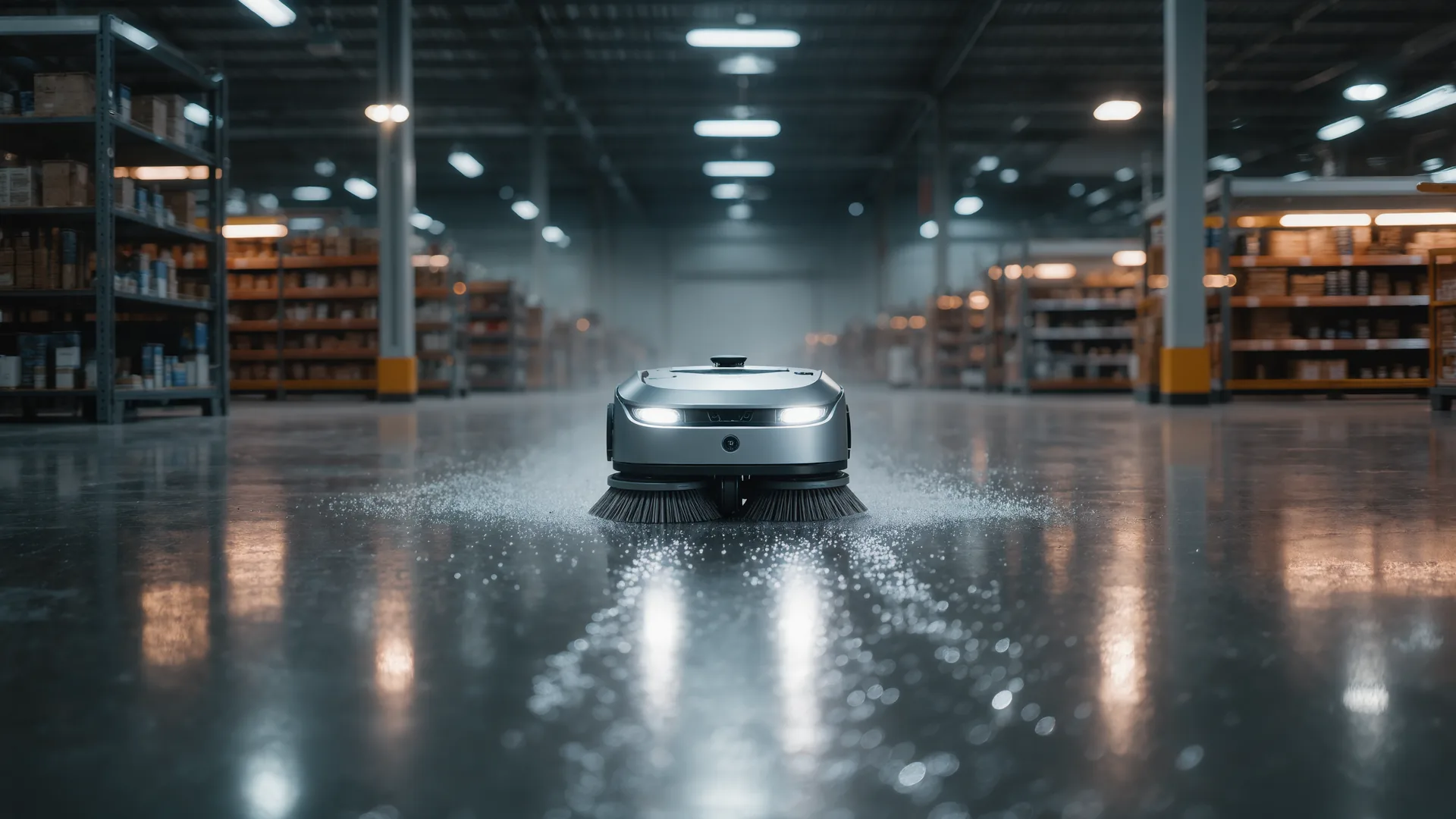
An autonomous scrubber costs 25,000 to 60,000 euro and covers 1,000 to 2,500 square metres per hour against 400 to 900 for a person with a walk-behind machine. It only saves money where large open floor dominates, because the robot takes the open area and leaves edges, corners, stairs, toilets and everything above floor level to a human who still has to be there.
What the robot actually takes
Cleaning a building is not one task. Breaking a typical contract into its parts shows immediately why the robot's share is bounded.
| Task | Share of hours | Robot can do it |
|---|---|---|
| Open floor scrubbing | 30 to 45 % | Yes, this is the target |
| Edges, corners, under fixtures | 8 to 15 % | No |
| Toilets and washrooms | 15 to 25 % | No |
| Waste collection | 8 to 12 % | No |
| Surfaces above floor level | 10 to 18 % | No |
| Stairs, lifts, entrances | 5 to 10 % | No |
| Spot response during the day | 5 to 10 % | No |
The arithmetic
| Item | Manual | Robot |
|---|---|---|
| Coverage rate | 650 m²/h | 1,600 m²/h |
| Hours per night | 18.5 | 7.5 |
| Nights per year | 300 | 300 |
| Labour hours per year | 5,550 | 2,250 supervision and edges |
| Labour at 19 euro/h | 105,450 | 42,750 |
| Machine amortisation, 5 years | 2,400 | 9,000 |
| Service, consumables, water, power | 3,200 | 6,800 |
| Annual total | 111,050 | 58,550 |
| Cost per m² per night | 0.031 | 0.016 |
That example works because the building is large, open and cleaned every night. Halve the area and the robot amortisation per square metre doubles while the human rate does not change. Clean three nights a week instead of seven and the machine sits idle for the same annual cost. Utilisation drives this decision exactly as it drives every other robot decision.
The conditions that decide it
- Contiguous open area above roughly 4,000 m². Below that the fixed cost per square metre rarely closes the gap.
- Cleaned at least five nights a week. Idle machines still amortise.
- Floor free of clutter at night. Pallets, roll cages and stock left in aisles turn a mapped route into a series of detours and a fault log.
- A person on site anyway. Nobody sends a robot into an unattended building for a full shift with no one to empty it, refill it or clear a fault.
- Lift access if there are floors. A robot that cannot call a lift cleans one storey.
The reason it sells anyway
Commercial cleaning has a recruitment problem in most developed markets, and night work is the hardest shift to fill. Where a contract cannot be staffed at any realistic wage, the comparison stops being cost against cost. A machine that takes 40 % of the hours turns an unstaffable contract into a staffable one, and that argument closes deals that a spreadsheet would not.
It also explains the growth pattern in the segment. Professional cleaning is one of the steadier categories in service robotics precisely because the labour constraint is structural rather than cyclical, and it does not reverse when wages move.
The second argument: data
Most autonomous scrubbers log where they cleaned, when, and how long. That turns a service nobody can verify into one with a record, and for a facility manager holding a contract that is worth something on its own.
| Use | Value |
|---|---|
| Proof of coverage per night | Ends the disputed-service argument |
| Square metres cleaned per shift | Contract measured rather than estimated |
| Missed areas flagged automatically | Corrective action the same night |
| Water and chemical consumption | Reporting for environmental targets |
| Machine hours and fault history | Service planning rather than breakdowns |
None of that reduces cost directly, and it changes the contract conversation. A cleaning contractor that can show 96 % coverage every night for a quarter is in a different negotiation from one that cannot, and several deployments have been justified on that basis alone.
Frequently asked questions
Does a cleaning robot save money?
On large contiguous floors cleaned nightly, yes, roughly halving cost per square metre in a worked example of 12,000 m². Below about 4,000 m² of open area, or on fewer than five nights a week, the fixed cost rarely closes the gap.
How much of a cleaning contract can a robot take?
Open floor scrubbing is 30 % to 45 % of the hours, and the robot reaches 60 % to 80 % of that area. Toilets, waste, edges, above-floor surfaces and stairs remain manual, which caps the addressable share around a third.
How fast is an autonomous scrubber?
1,000 to 2,500 square metres per hour against 400 to 900 for a person with a walk-behind machine, so roughly two to three times faster on the area it can actually reach.
What stops them in practice?
Clutter. Pallets, roll cages and stock left in aisles at night turn a mapped route into detours and faults, and the fix is a housekeeping discipline rather than a software update.
Why do they sell where the numbers are marginal?
Because night cleaning shifts are the hardest to staff in most developed markets. A machine that removes 40 % of the hours can turn an unstaffable contract into a staffable one, which is an argument no cost comparison captures.
Sources
- World Robotics 2025 report, service robotsInternational Federation of Robotics, professional cleaning segment
- World Robotics report seriesInternational Federation of Robotics, service robot methodology
- ISO 3691-4, safety requirements for driverless industrial trucksInternational Organization for Standardization, applies to autonomous cleaning machines in shared space