Field and Service Robotics
Milking Robots: The Payback Almost Nobody Disputes
More than 25,000 milking robots are running worldwide. Payback ranges from 3.2 to 12 years, and the spread depends almost entirely on what the robot replaces.
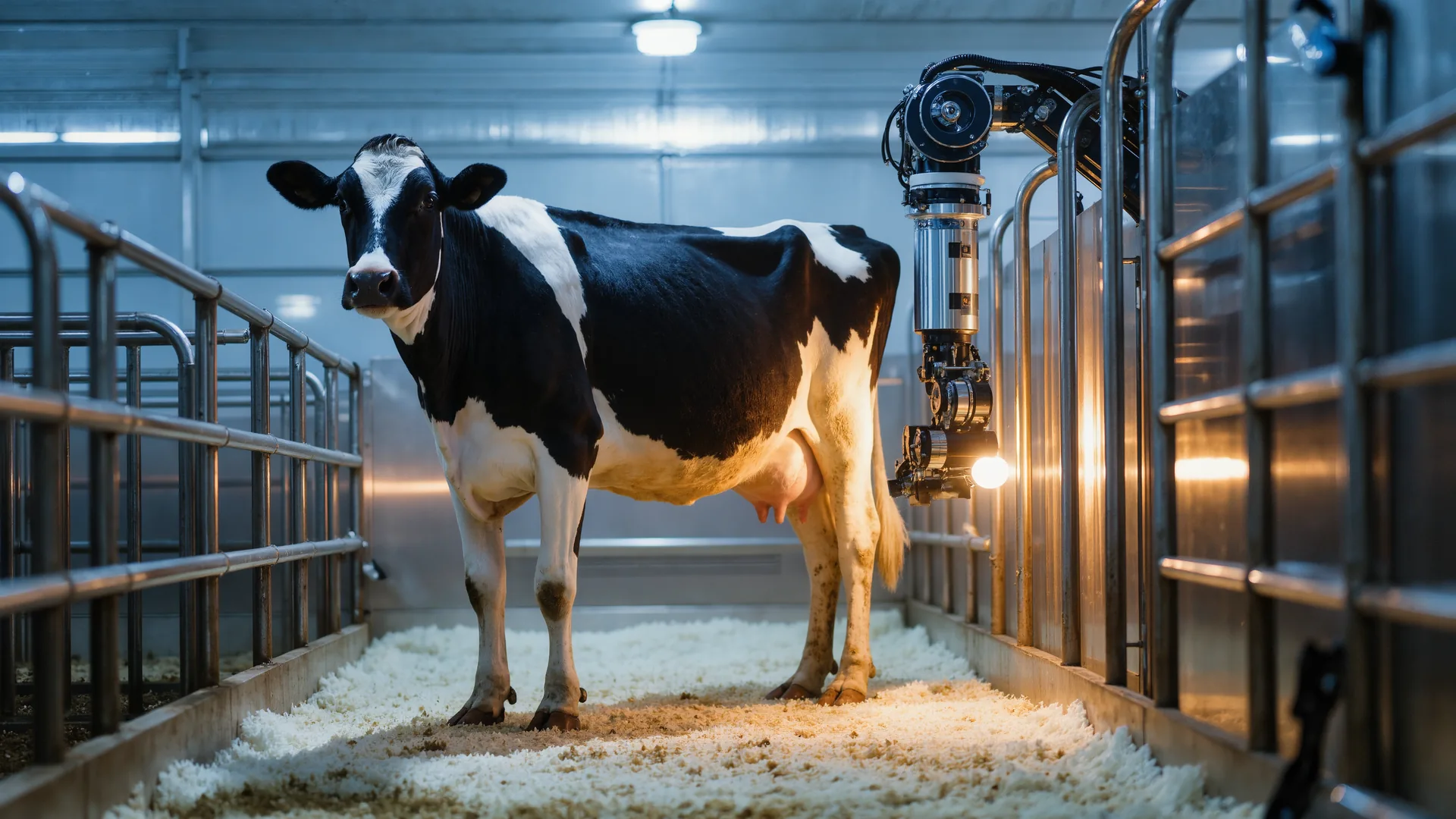
Automatic milking is the oldest genuinely successful agricultural robot, with more than 25,000 units in operation. A box costs 165,000 to 200,000 US dollars, or 200,000 to 300,000 installed with barn work, and handles 50 to 70 cows. Published payback runs from 3.2 years to 12 years, and the entire spread comes from one question: what is it replacing.
The cost side
| Item | Figure | Note |
|---|---|---|
| Robot box, equipment only | 165,000 to 200,000 | Varies by manufacturer and configuration |
| Installed, including barn modification | 200,000 to 300,000 | The number that belongs in a business case |
| Cows per robot | 50 to 70 | High-yield herds target 50 to 60 |
| Cost per cow, 120-cow herd | 3,200 to 3,800 | Including facility work |
| Labour reduction | ≈ 32 % | The dominant benefit line |
| Payback, favourable case | ≈ 3.2 years | High labour cost, replacing an old parlour |
| Payback, extension studies | 3.8 to 5.2 years | Independent analyses |
| Payback against a modern 2x parlour | 5 to 12 years | 80 to 400 cows |
Why this one works when other farm robots do not
Milking has four properties that almost no other agricultural task shares, and together they explain a 25,000-unit installed base while field robots remain a few thousand.
- The environment is fixed. The barn is built, lit, flat and unchanging. No weather, no terrain, no seasonality in the workspace itself.
- The target comes to the robot. Cows walk in voluntarily for feed. The machine does not have to travel, search or navigate.
- The task repeats identically two to three times per cow per day, every day of the year. Utilisation is near continuous rather than seasonal.
- The labour it replaces is the worst kind. Milking is unavoidable, twice daily, at fixed hours, seven days a week. That is the constraint on a dairy family's life, and it is why the decision is often taken on lifestyle grounds before the spreadsheet is opened.
Compare that with harvesting: outdoor, seasonal, terrain-variable, target must be found and assessed, and the labour is concentrated into a few weeks. Every property is inverted.
Where the money actually comes from
| Line | Typical effect | Confidence |
|---|---|---|
| Labour reduction | ≈ 32 % | high, measured |
| Milk yield per cow | +5 to 12 % | moderate, herd dependent |
| Milking frequency | 2.5 to 3.0 per day against 2 | high |
| Udder health data and early detection | variable | moderate |
| Labour availability, where none can be hired | decisive | high |
| Lifestyle, no fixed milking hours | not monetised | the actual reason, often |
| Electricity and maintenance | a cost, not a saving | high |
The yield line deserves care. Robots milk more frequently, and more frequent milking raises yield in high-producing cows, but the gain is not automatic and depends on cow traffic, feed strategy and barn layout. A business case that assumes the top of the range without a herd-specific reason is optimistic.
Where it goes wrong
- Barn layout fights cow traffic. Robots need cows to present themselves. A layout that makes the walk to the box awkward produces fetch cows, and fetching cows is exactly the labour the robot was bought to remove.
- Herd size does not match the box count. Sixty cows per robot is a ceiling, not a target. Pushing to 75 produces queues, lower frequency and unhappy cows.
- Udder conformation. A proportion of any herd cannot be milked robotically without culling or breeding changes, and that proportion should be measured before purchase.
- Service response. A robot down at 03:00 is a herd that is not being milked. Distance to a technician is a real specification.
- The labour was not actually paid. On a family farm where milking labour is unpaid family time, the 32 % reduction saves no cash, and the case rests entirely on lifestyle and yield.
Frequently asked questions
What does a milking robot cost?
Roughly 165,000 to 200,000 US dollars for the box, or 200,000 to 300,000 installed including barn modifications. On a 120-cow herd that works out at 3,200 to 3,800 per cow.
How many cows can one robot handle?
50 to 70, with high-producing herds usually targeting 50 to 60. Pushing beyond that produces queuing, lower milking frequency and more cows that have to be fetched.
What is the payback period?
Between about 3.2 years in favourable cases and 5 to 12 years against a modern parlour on an 80 to 400 cow herd. Independent extension studies cluster at 3.8 to 5.2 years. What the robot replaces explains almost all of the spread.
Why do milking robots succeed where field robots struggle?
The barn is a fixed, controlled environment, the cows come to the machine, the task repeats identically two to three times daily all year, and the labour replaced is unavoidable twice-daily work. Field tasks invert every one of those properties.
What is the most common mistake?
Barn layout that discourages voluntary cow traffic. Cows that have to be fetched consume exactly the labour the robot was bought to remove, and the layout cannot be fixed cheaply afterwards.
Sources
- Automatic milking systems: the good, the bad, and the unknownNebraska Dairy Extension, University of Nebraska
- Automatic milking system considerations, W 1188University of Tennessee Institute of Agriculture
- Dairy robotic milking systems: what are the economics?DAIReXNET, US Cooperative Extension
- World Robotics 2025 report, service robotsInternational Federation of Robotics, agricultural robot segment