Field and Service Robotics
Robots in Nuclear Decommissioning: The Oldest Hard Case
Nuclear was using teleoperated manipulators decades before industrial robots existed, and it still uses them. Radiation is why autonomy stops at the reactor hall door.
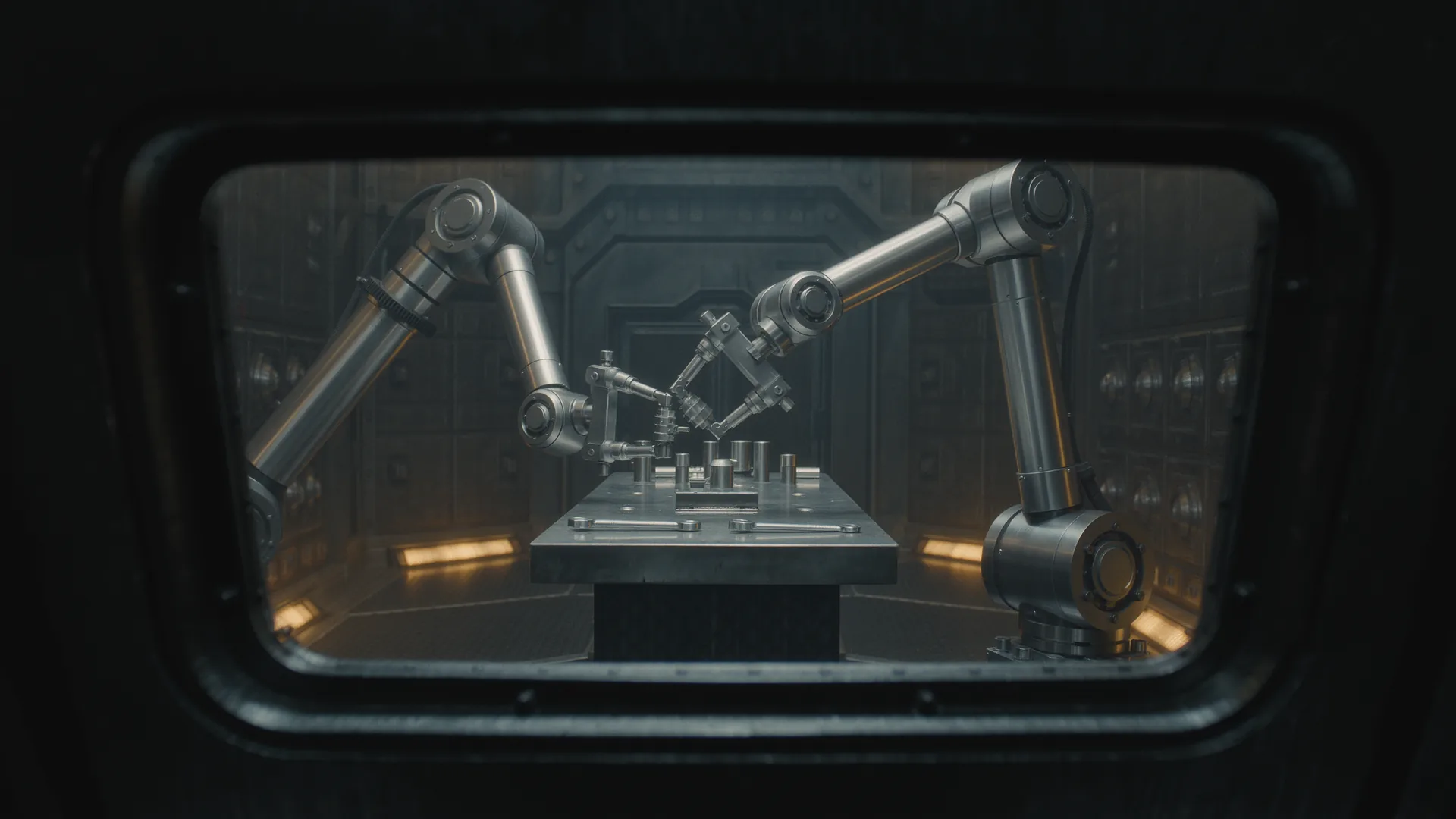
Nuclear had remote manipulation before industry had robots, and it is still the sector where teleoperation beats autonomy. The reason is physical: gamma radiation destroys the semiconductors that autonomy runs on. Commercial image sensors degrade visibly at cumulative doses in the region of tens to hundreds of gray, and a hot cell can deliver that in hours. A machine that thinks is a machine with more to lose.
What radiation does to a robot
| Component | Failure mode | Relative tolerance |
|---|---|---|
| CMOS image sensors | Bright pixels, then washed-out image | lowest |
| Modern high-density processors | Bit errors, latch-up, permanent failure | very low |
| Memory | Corruption, then hard failure | very low |
| Optocouplers and analogue parts | Drift, gain loss | low |
| Polymers, cable insulation, seals | Embrittlement, cracking | moderate |
| Lubricants | Degradation, hardening | moderate |
| Motors and mechanics | Largely tolerant | high |
| Hydraulics and mechanical linkages | Essentially tolerant | highest |
Read that ordering carefully, because it inverts the usual robotics hierarchy. The parts that make a machine autonomous fail first, and the parts that make it a mechanism survive longest. That is why the classic nuclear manipulator is a mechanical master-slave linkage through a shielded wall with no electronics in the hot zone at all, and why that design is still in service.
The numbers a programme works with
| Environment | Typical dose rate | Time to 100 Gy | What can operate |
|---|---|---|---|
| Accessible plant area | under 0.01 mGy/h | years | Standard robots and sensors |
| Controlled area, low | 0.1 to 10 mGy/h | months to years | Standard hardware, shielded electronics |
| Fuel pond area | 1 to 100 mGy/h | weeks to months | Hardened cameras, replaceable optics |
| Hot cell | 1 to 100 Gy/h | 1 to 100 h | Teleoperation, electronics outside |
| Damaged reactor internals | above 100 Gy/h | under 1 h | Mechanical linkage, sacrificial hardware |
The right-hand column is the design brief. In the bottom two rows a commercial camera has a working life measured in hours, and any processor on board is a component that will fail during the shift rather than during the year. Every architectural choice follows from that single row.
What the robots actually do
- Characterisation. Mapping dose rates and contamination before anything is touched. This is the first task on any programme and it defines everything that follows.
- Size reduction. Cutting large contaminated structures into pieces that fit a waste container. Plasma, saw and shear tools on manipulators, which is the volume work of decommissioning.
- Waste handling and sorting. Separating material by activity level, because disposal cost scales steeply with classification.
- Decontamination. Surface removal by abrasive, laser or chemical means to downgrade material from one waste class to a cheaper one.
- Inspection in places people cannot go. Reactor internals, fuel ponds, ducts and cells.
Point three and four are where the money is. Waste disposal cost is driven by classification and volume, so a robot that sorts accurately or decontaminates a surface enough to drop a category saves more than one that merely works faster.
The scale of the work
| Quantity | Typical range | Note |
|---|---|---|
| Programme duration | 20 to 100 years | Including deferred dismantling periods |
| Steel and concrete to be removed, one reactor | 100,000 to 1,000,000 t | The great majority conventional |
| Share that is radioactive waste | 1 to 5 % | Sorting decides which side material lands on |
| Cobalt-60 half-life | 5.27 years | Why deferring dismantling reduces dose |
| Caesium-137 half-life | 30.1 years | Dominates medium-term contamination |
| Dose reduction after 30 years of decay | roughly 50 to 60x for cobalt-60 | The argument for waiting |
| Manipulator pairs in a large hot cell facility | 10 to 60 | Master-slave through the shielding wall |
The half-life rows explain a strategy that looks like inaction. Waiting 30 years before dismantling reduces the cobalt-60 dose by a factor of roughly 50, which turns a hot cell task into a controlled area task and lets ordinary equipment do work that would otherwise need shielded manipulators. Time is a decommissioning tool, and it is free.
Why sorting beats speed
Disposal cost scales with waste class far more steeply than with volume, so the machine that classifies correctly saves more than the machine that cuts faster.
| Class | Route | Relative disposal cost | Effect of a wrong call |
|---|---|---|---|
| Exempt or clearance | Conventional recycling | 1x | Cheapest possible outcome |
| Very low level | Near-surface disposal | 5 to 20x | Modest overspend |
| Low level | Engineered near-surface facility | 30 to 150x | Significant overspend |
| Intermediate level | Shielded store, geological disposal | 300 to 3,000x | Very large overspend |
| High level | Long-term geological disposal | above 5,000x | Programme-scale consequence |
Cost multiples are indicative and vary by country and facility, and the shape is universal: dropping one class is worth an order of magnitude. A decontamination robot that removes 2 mm of contaminated surface from a steel plate and takes it from intermediate to low level has done something no cutting speed can match. That is also why characterisation, the least visible task, is the one that gets funded first.
Design rules that come from the environment
| Property | Industrial practice | Nuclear practice |
|---|---|---|
| Electronics location | On the machine | Outside the shielding wherever possible |
| Autonomy | Maximise | Minimise, keep a human deciding |
| Recoverability | Assumed | Designed for, tether accepted |
| Repair | Replace the failed part | Often impossible, plan redundancy |
| Materials | Chosen for cost and mass | Chosen for radiation and decontamination |
| Component life | Years | Sometimes a single campaign |
| Cameras | Best available sensor | Radiation-tolerant, lower quality, replaceable |
| Cost of failure | Downtime | New waste stream |
Where autonomy is arriving anyway
Not in the hot cell, but around it. Autonomy is being adopted for the tasks where a failure is recoverable: surveying accessible areas, building three-dimensional maps for planning, monitoring stores and ponds, and assisting an operator by handling collision avoidance while the human decides what to cut. That division, machine handles the geometry and the human handles the judgement, is the same shared-autonomy pattern emerging in surgery, and for the same reason.
The other change is duration. Decommissioning programmes run for decades, which is long enough that a robot deployed at the start will be obsolete and unsupported before the work finishes. Designing for component replacement across generations is a requirement no factory robot ever faces.
Frequently asked questions
Why is nuclear robotics still teleoperated?
Because radiation destroys the components autonomy depends on. Image sensors, processors and memory are the most sensitive parts of any robot, while motors and mechanical linkages are the most tolerant, so the mechanism survives and the intelligence does not.
What happens if a robot fails inside a hot cell?
It cannot be retrieved by hand. It becomes an obstacle and eventually radioactive waste that must be characterised, cut up and disposed of at nuclear rates, which is why recoverability outranks capability in every design decision.
What tasks do the robots perform?
Characterisation of dose and contamination, size reduction of large structures, waste sorting by activity, surface decontamination to downgrade waste class, and inspection of reactor internals, ponds and ducts.
Where does the economic value sit?
In waste classification and volume. Disposal cost rises steeply with activity class, so sorting accurately or decontaminating a surface enough to drop a category saves far more than working faster.
Is autonomy being adopted at all?
Yes, outside the hot cell: surveying accessible areas, building maps for planning, monitoring stores, and assisting operators with collision avoidance while the human decides what to cut. Shared autonomy rather than full autonomy.
Sources
- Decommissioning of nuclear facilitiesInternational Atomic Energy Agency, programme scope and waste classification
- Robotics at NISTNational Institute of Standards and Technology, test methods for remote and response robots
- arXiv robotics preprints, robotics in hazardous environmentsPrimary literature on teleoperation and shared autonomy