Field and Service Robotics
Why Fruit Picking Robots Are Still Not Good Enough
Harvesting robots reach 60 to 90 percent detection and pick one fruit every 4 to 12 seconds. A human picks one every 1 to 3 seconds and misses nothing. That gap is the whole story.
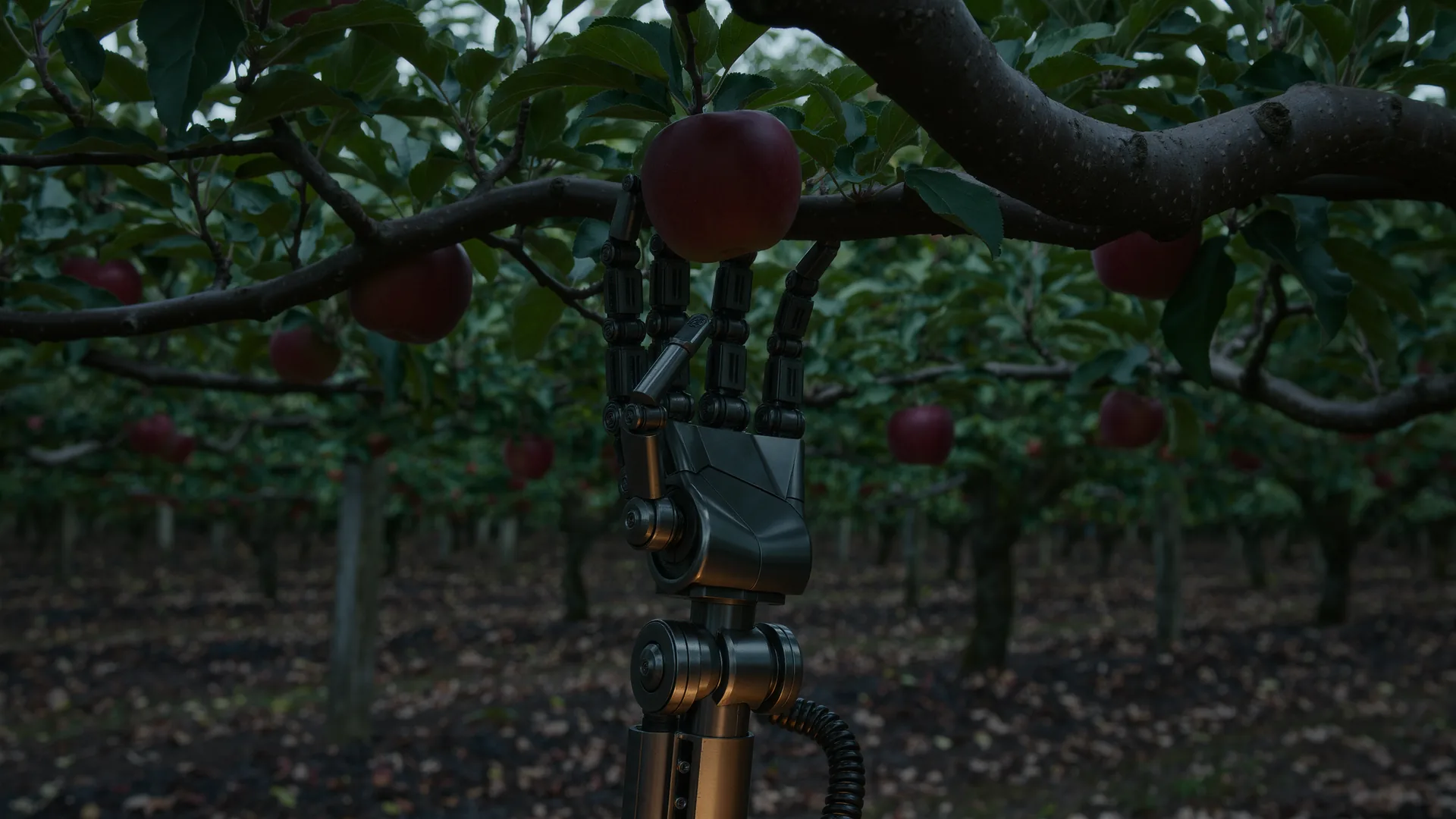
A skilled picker takes a fruit every 1 to 3 seconds and leaves almost nothing behind. Published harvesting robots detect 60 % to 90 % of visible fruit and take 4 to 12 seconds per successful pick, with damage rates that a packhouse notices. Closing a four-to-tenfold speed gap while raising detection to commercial levels is the problem, and neither half is nearly solved.
Four problems, and they multiply
| Problem | Why it is hard | Typical performance |
|---|---|---|
| Detection | Fruit is occluded by leaves, other fruit and branches, and lit unpredictably | 60 to 90 % of visible fruit |
| Ripeness assessment | Colour alone is a poor proxy; firmness and sugar matter and are not visible | variable, crop dependent |
| Reaching | Branches obstruct the approach even when the fruit is seen | many detections unreachable |
| Detaching without damage | Each crop has its own release mechanic, and bruising appears days later | the packhouse decides |
These multiply rather than add. A machine that detects 85 % of fruit, can reach 80 % of what it detects, and detaches 90 % of what it reaches without damage delivers 0.85 x 0.80 x 0.90 = 61 % of the crop in sellable condition. The remaining 39 % still needs a human pass, and once a human pass is scheduled the economic argument largely collapses.
Damage is the constraint nobody sees in a demo
Bruising does not appear at the moment of picking. It appears in the packhouse, or worse, at the retailer days later. A robot that looks flawless in a field demonstration can produce a downgrade rate that turns a Class I crop into Class II, and the price difference between those grades routinely exceeds the entire picking cost.
That is why the honest specification for a harvesting robot is not picks per hour. It is sellable Class I kilograms per hour, measured after grading, and very few published figures are stated that way.
Where it does work
- Crops that release easily and bruise little. Some varieties detach with a defined twist or pull and tolerate handling. Those are the ones where machines reach commercial trials first.
- Protected cropping. Glasshouse tomatoes, peppers and cucumbers grow on trained vines in a structured, flat, climate-controlled environment. That removes terrain, weather and most occlusion, which is why the earliest commercial systems appeared there.
- Processing crops. Where the fruit is destined for juice or paste, cosmetic damage matters far less and the detection bar drops.
- Yield estimation rather than picking. The same perception stack that struggles to pick reliably is good enough to count fruit and forecast yield, which is a real and already commercial product.
The fourth point deserves emphasis. Several companies that set out to build harvesters now sell scouting and yield forecasting, because the perception works and the manipulation does not. That is a legitimate outcome rather than a failure.
What would change the picture
| Lever | Effect | Status |
|---|---|---|
| Training systems designed for machines | Fruit presented on a plane, occlusion largely removed | strongest lever, slow to adopt |
| Multiple arms on one platform | Throughput scales nearly linearly | in commercial trials |
| Better perception models | Detection rate rises, reachability does not | improving steadily |
| Soft and adaptive end effectors | Damage falls | active development |
| Breeding for machine harvest | Uniform ripening, easier release | decade-scale |
The first row is the one that historically works. Mechanised harvest arrived in other crops when the crop was changed to suit the machine, not when the machine learned to handle the crop. Orchards planted today on two-dimensional trellis systems are the version of that argument being tested now, and results will take as long as the trees take to bear.
Frequently asked questions
Why can robots not pick fruit reliably?
Four problems multiply: detecting occluded fruit, judging ripeness, reaching past branches and detaching without bruising. A machine at 85 %, 80 % and 90 % on the last three delivers 61 % of the crop in sellable condition.
How fast is a harvesting robot?
Four to twelve seconds per successful pick in published work, against one to three seconds for a skilled human picker. That is a four to tenfold gap before detection and damage losses are counted.
Why does a second human pass matter so much?
Because harvesting labour is expensive to have available, not expensive per fruit. If a crew still has to be recruited and present, shortening its work does not remove the cost that made automation attractive.
Where are harvesting robots already working?
Protected cropping, where tomatoes, peppers and cucumbers grow on trained vines in flat, climate-controlled, structured environments. Processing crops are the second case, because cosmetic damage matters less.
What would fix it fastest?
Changing the crop rather than the robot. Training systems that present fruit on a plane remove most occlusion and reachability failures at once, which is how mechanisation arrived in other crops historically.
Sources
- arXiv robotics preprints, agricultural robotics and harvestingPrimary literature on detection rates, cycle times and damage
- World Robotics 2025 report, service robotsInternational Federation of Robotics, agriculture segment volumes
- Robotics at NISTNational Institute of Standards and Technology, grasping and manipulation measurement