Field and Service Robotics
What a Surgical Robot Costs, Instruments Included
A surgical system lists at 1.8 to 2.5 million dollars, service runs 100,000 to 170,000 a year, and instruments add 600 to 3,500 per procedure. The volume needed to justify it is the real number.
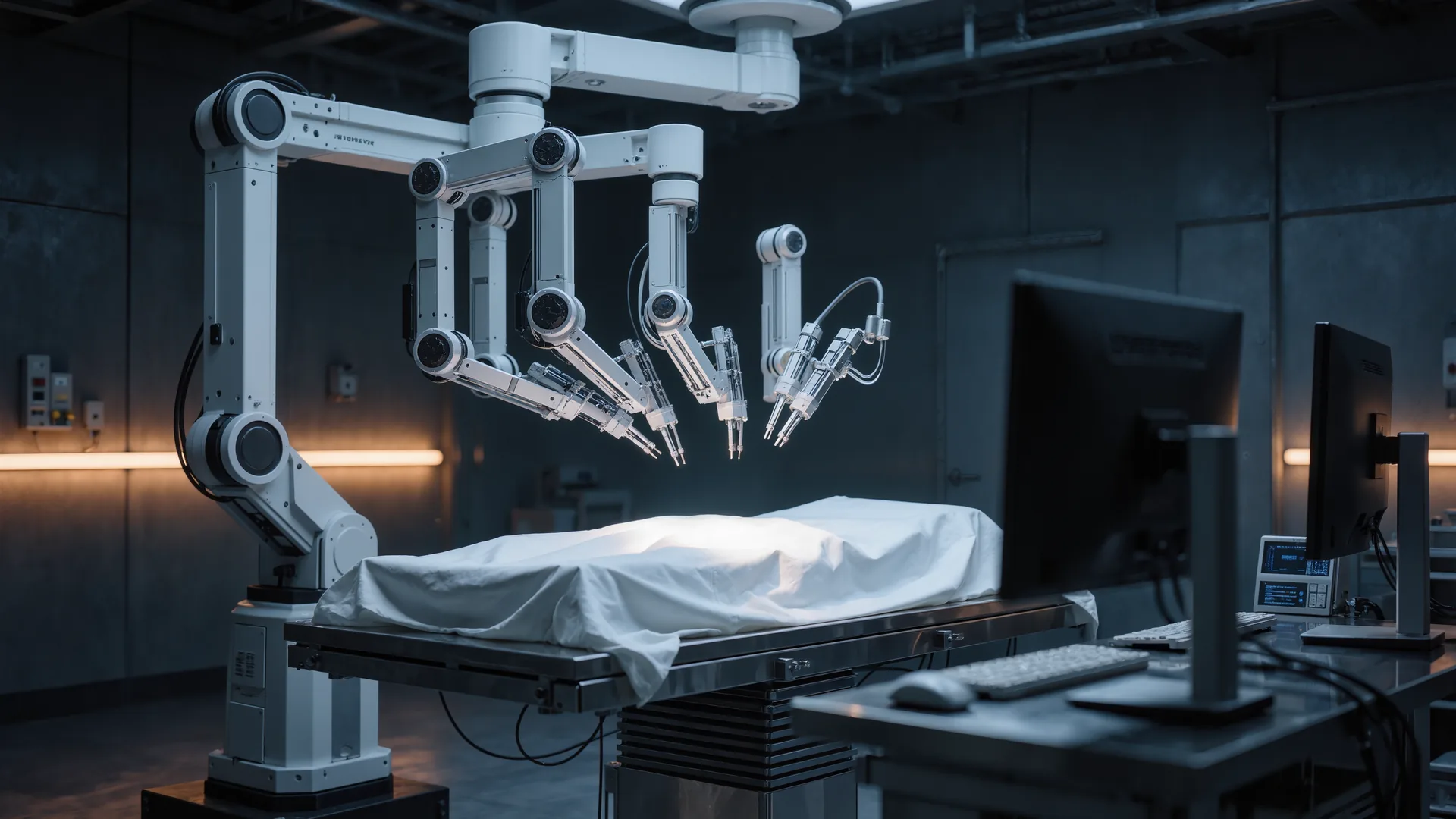
The system is the smallest of the three costs over a working life. A current-generation platform lists at 1.8 to 2.5 million US dollars, annual service runs 100,000 to 170,000, and consumable instruments add 600 to 3,500 per procedure. At the market average of just over 300 procedures per system per year, instruments alone are 180,000 to over 1 million annually, which is why utilisation decides whether the purchase was sound.
The market in numbers
One manufacturer dominates the installed base and files its figures, which makes this one of the few robotics segments with audited data rather than estimates.
| Figure | 2024 | 2025 | Change |
|---|---|---|---|
| Installed systems worldwide | 9,902 | 11,106 | +12 % |
| Systems placed during the year | 1,526 | 1,721 | +13 % |
| of which the newest platform | 362 | 870 | +140 % |
| Procedures performed | ≈ 2.6 M | above 3.1 M | +18 % |
| Procedure growth, United States | +15 % | ||
| Procedure growth, international | +23 % | ||
| Utilisation per system | just above 300 | +3 % |
Read the last row against the first. The installed base grew 12 % while utilisation grew only 3 %, which means the fleet is expanding roughly four times faster than the average system is being used harder. For a hospital that is the crucial signal: the marginal new system is going into a site with lower volume than the existing average.
The cost stack over five years
| Item | 100 cases/yr | 300 cases/yr | 600 cases/yr |
|---|---|---|---|
| System purchase | 2,150,000 | 2,150,000 | 2,150,000 |
| Service, 5 years at 135,000 | 675,000 | 675,000 | 675,000 |
| Instruments at 2,000 per case | 1,000,000 | 3,000,000 | 6,000,000 |
| Five-year total | 3,825,000 | 5,825,000 | 8,825,000 |
| Cost per case | 7,650 | 3,883 | 2,942 |
Why instruments behave differently
Robotic instruments are life-limited by design: each carries a counter and stops working after a set number of uses, commonly around ten. That converts what a surgeon would think of as capital equipment into a per-case consumable, and it is the reason the instrument line dominates the five-year total at any serious volume.
- Case complexity drives the count. A simple procedure may use three or four instruments; a complex one uses seven or more, plus a stapler and energy devices.
- Speciality matters more than the surgeon. Urology and gynaecology procedures sit at the lower end of the consumable range, general surgery and thoracic at the higher end.
- Reprocessing is not available the way it is for conventional laparoscopic instruments, which removes a lever hospitals are used to pulling.
What a hospital actually has to show
- Committed volume, not hoped-for volume. Named surgeons with named case types, because the fixed cost is incurred whether the theatre list fills or not.
- Length of stay effects, measured on the hospital's own historical cases rather than borrowed from a paper. This is where the offsetting saving lives if it exists.
- Theatre time. Early robotic cases run longer than open or laparoscopic equivalents, and theatre time is expensive. The learning curve is a real cost in the first year.
- Recruitment and retention. In competitive markets the system attracts surgeons, and that is a genuine but rarely quantified benefit.
- The counterfactual. Against laparoscopic surgery the economics are hard. Against open surgery, where length of stay differences are largest, they are considerably better.
What changes next
The installed base is concentrated with one manufacturer, and that is beginning to shift as competing platforms reach approval in more markets. Two consequences follow for a buyer. First, negotiating position improves, particularly on service and instrument pricing, which are the recurring lines that matter. Second, an instrument ecosystem tied to one platform becomes a switching cost worth pricing at purchase rather than at replacement.
Frequently asked questions
How much does a surgical robot cost?
A current-generation system lists at roughly 1.8 to 2.5 million US dollars, with annual service of 100,000 to 170,000 and instruments of 600 to 3,500 per procedure. Over five years at 300 cases a year the total lands near 5.8 million.
How many procedures does a system need to be viable?
The global average is just over 300 procedures per system per year. Below roughly 100 cases annually the cost per case exceeds 7,500 US dollars, because system and service costs are fixed and spread across very few patients.
Why are instruments so expensive?
They are life-limited by design, typically expiring after around ten uses, and cannot be reprocessed the way conventional laparoscopic instruments are. That makes them a per-case consumable rather than capital equipment.
How large is the installed base?
11,106 systems worldwide at the end of 2025, up 12 % from 9,902 a year earlier, with 1,721 systems placed during 2025 and more than 3.1 million procedures performed.
Is the growth in systems or in usage?
Mostly systems. The installed base grew 12 % in 2025 while utilisation per system grew 3 %, so the fleet is expanding roughly four times faster than average usage intensity.
Sources
- Intuitive Surgical, Form 10-K for FY2025US Securities and Exchange Commission, installed base, placements, procedures and utilisation
- Robot-assisted surgery compared with open and laparoscopic surgery: clinical effectiveness and economic analysesHealth technology assessment, per-centre costs of system, maintenance, consumables and training
- World Robotics 2025 report, service robotsInternational Federation of Robotics, medical robotics as a growth segment