Field and Service Robotics
ROV vs AUV: Which Underwater Robot for Which Job
An ROV is tethered, powered from the surface and can intervene. An AUV runs free for hours and only surveys. The tether decides which one your job needs.
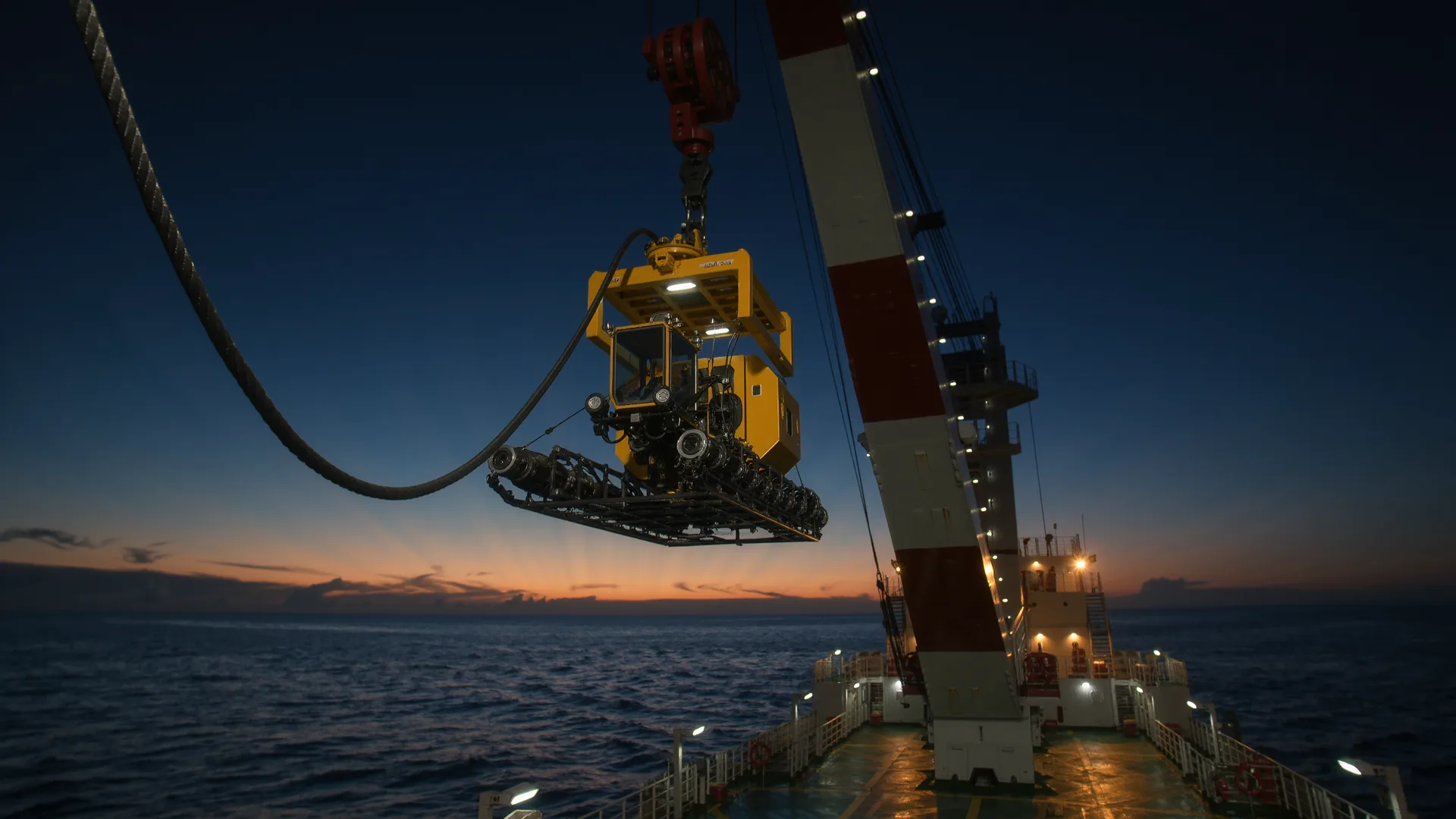
The tether decides it. An ROV takes power and commands down a cable, so it has unlimited endurance, full video bandwidth and an arm that can turn a valve, and it needs a vessel holding station above it. An AUV carries its own battery for 8 to 60 hours, covers ground far faster, and can only look. Intervention needs a tether; survey does not.
The two families
| Property | ROV | AUV |
|---|---|---|
| Power | From the surface, unlimited | Internal battery, 8 to 60 h |
| Control | Live pilot, full video | Pre-programmed, acoustic link only |
| Manipulation | Yes, one or two arms | No |
| Survey speed | 0.5 to 1.5 knots | 3 to 5 knots |
| Support vessel | Required, holding station | Launch and recovery only |
| Depth rating, work class | to 6,000 m | to 6,000 m |
| Data return | Live | On recovery, or summaries acoustically |
| Day rate including vessel | very high | high, shorter vessel time |
| Typical use | Intervention, close inspection, construction | Pipeline and seabed survey, hydrography |
The categories in between
- Observation-class ROV. A small tethered vehicle with cameras and no manipulator, launched from a small boat or a quayside. Cheap, useful for hull and harbour inspection, and the entry point for most operators.
- Hybrid ROV. Operates free-swimming for survey, then connects to a light fibre tether for intervention. It buys flexibility at the cost of complexity.
- Resident systems. A vehicle that lives on the seabed in a docking station, charging and uploading through it, deployed on demand without a vessel at all. This is the structural change in the industry, because it removes the vessel from routine inspection entirely.
- Underwater crawler. Drives on the structure or seabed rather than swimming, which gives stability for contact measurement in current.
Resident systems deserve the attention. If the vessel is the dominant cost, a vehicle that never needs one converts inspection from a mobilised campaign into a scheduled routine, and that is a different business rather than a cheaper one.
Sensor payloads and what they cost in endurance
| Sensor | Measures | Power | Range |
|---|---|---|---|
| Multibeam echosounder | Seabed bathymetry | 30 to 90 W | up to 200 m |
| Side-scan sonar | Seabed imagery | 15 to 50 W | 50 to 200 m per side |
| Sub-bottom profiler | Layers below the seabed | 20 to 80 W | 5 to 50 m penetration |
| Doppler velocity log | Speed over ground for navigation | 10 to 30 W | up to 200 m altitude |
| Camera and lighting | Visual detail | 50 to 400 W | 1 to 10 m |
| Ultrasonic thickness probe | Steel wall thickness | 5 to 20 W | contact |
The camera row explains why free-swimming vehicles survey with sonar rather than with pictures. Lighting is the single largest power draw on any underwater platform, and turning it on can halve the endurance of a battery-powered vehicle, which is exactly the resource an AUV cannot spare.
What makes underwater hard
- No radio. Water blocks the frequencies used for radio and satellite navigation, so there is no GPS below the surface and no high-bandwidth wireless link. Acoustic communication offers low data rates with seconds of latency.
- Navigation drifts. Without an absolute reference, position comes from inertial sensors and a Doppler velocity log, and error accumulates over the dive unless corrected against acoustic beacons or seabed features.
- Visibility is often metres or less. Sonar does the work that cameras do on land, and interpreting sonar is a skill.
- Pressure. Every 10 m adds roughly one atmosphere, so a 3,000 m vehicle sits under about 300 bar and every penetration and housing is a design problem.
- Current. Station keeping in a 2 knot current consumes most of the thrust a small vehicle has, which is exactly when the inspection is needed.
Choosing in four questions
| Question | If yes |
|---|---|
| Does anything need to be touched, turned or cut? | ROV, work class |
| Is the job covering distance rather than examining a point? | AUV |
| Does the data need to be seen live? | ROV |
| Is this a repeating routine on a fixed asset? | Resident system |
| Is it shallow, short and visual? | Observation-class ROV |
| Is contact measurement needed in current? | Crawler |
Frequently asked questions
What is the difference between an ROV and an AUV?
An ROV is tethered, powered from the surface, piloted live and can carry manipulators. An AUV runs free on internal battery for 8 to 60 hours, follows a pre-programmed mission, surveys three to four times faster and cannot touch anything.
Which is cheaper?
Neither vehicle dominates on price; the support vessel does. An ROV needs a vessel holding station for the whole dive, while an AUV lets the ship transit between deployments, and that difference in vessel time usually decides project cost.
Why is there no GPS underwater?
Water absorbs the radio frequencies satellite navigation uses. Position comes from inertial sensors with a Doppler velocity log, corrected against acoustic beacons or recognised seabed features, and it drifts without those corrections.
What is a resident system?
A vehicle that lives on the seabed in a docking station, charging and transferring data through it, deployed on demand without a support vessel. It converts inspection from a mobilised campaign into a scheduled routine.
How deep do these vehicles work?
Work-class ROVs and large AUVs are commonly rated to 6,000 m, which covers the great majority of the ocean floor. At 3,000 m the vehicle sits under roughly 300 bar, so every housing and penetration is a pressure design problem.
Sources
- World Robotics 2025 report, service robotsInternational Federation of Robotics, inspection and maintenance robot segment
- Robotics at NISTNational Institute of Standards and Technology, robot performance and test methods
- arXiv robotics preprints, underwater robotics and navigationPrimary literature on acoustic navigation and autonomous underwater vehicles