Safety and Standards
Who CE-Marks a Robot Cell?
The robot arrives as partly completed machinery with a declaration of incorporation. Whoever assembles the cell becomes its manufacturer and CE-marks the result. Here is what that means.
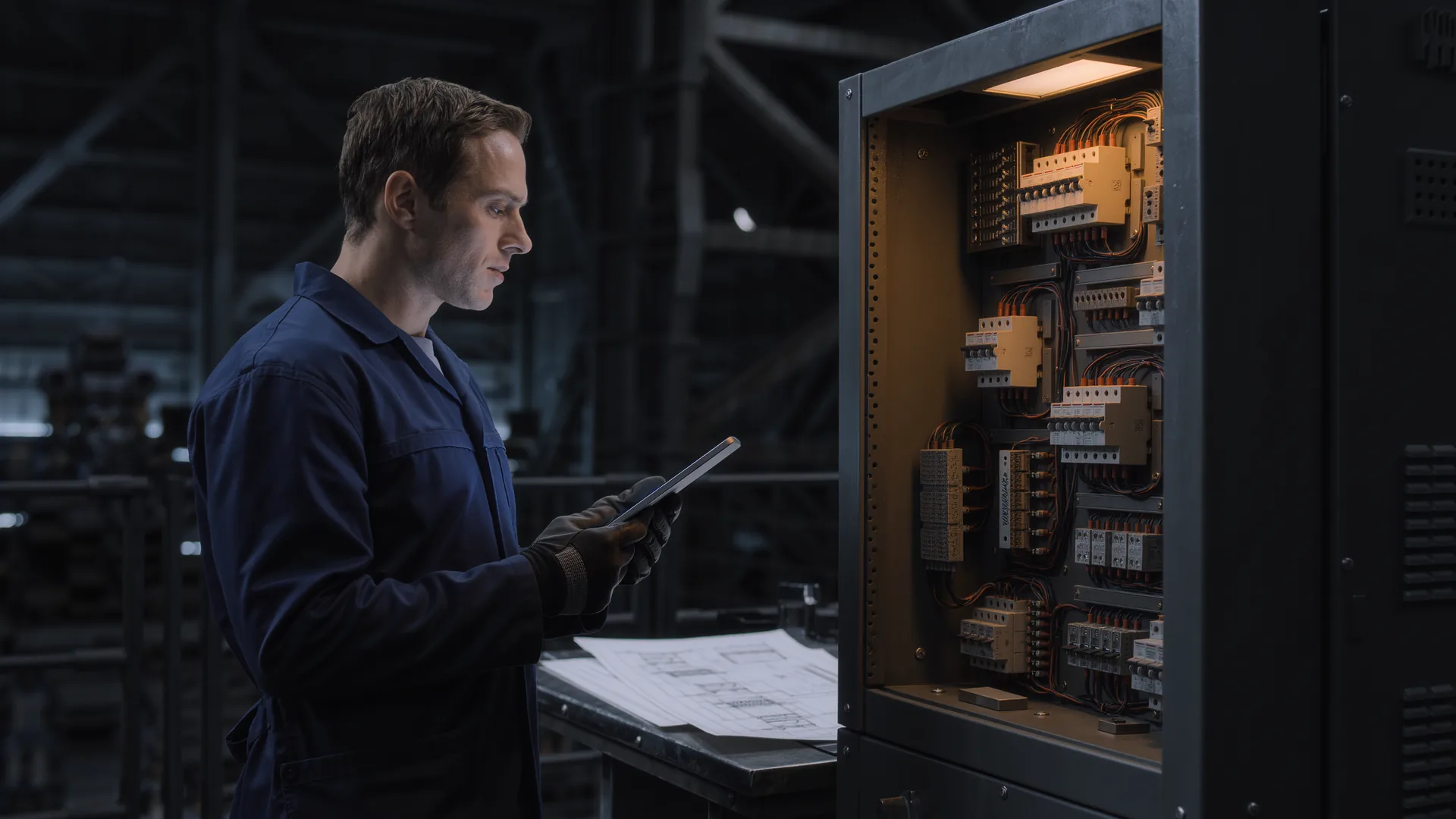
Whoever puts the complete cell into service. A robot is supplied as partly completed machinery with a declaration of incorporation, not a declaration of conformity, precisely because it cannot function safely on its own. The organisation that adds a gripper, a fixture, a guard and a program has created a new machine and is its manufacturer, with every obligation that follows, including in-house cells built by the operating company itself.
The two declarations
| Property | Declaration of incorporation | Declaration of conformity |
|---|---|---|
| Applies to | Partly completed machinery | Complete machinery |
| Comes with the robot | Yes | No |
| Permits CE marking | No | Yes |
| States | Which requirements are met, which are not | Full conformity |
| Accompanied by | Assembly instructions | Operating instructions |
| Who issues it | Robot manufacturer | Whoever completes the machine |
What the manufacturer of the cell must do
- Carry out a risk assessment covering the complete cell across its whole life cycle, including maintenance and foreseeable misuse.
- Apply the essential health and safety requirements, using harmonised standards where they exist, which for robots means ISO 10218 and its supporting documents.
- Compile the technical file: drawings, calculations, safety function specifications and their validation, measurement reports, component declarations and the standards applied.
- Verify the safety functions, including the required performance level for each and its validation under fault conditions.
- Write operating instructions in the language of the country of use, covering intended use and foreseeable misuse.
- Issue the declaration of conformity and affix the CE mark to the complete cell.
- Retain the documentation for ten years after the last unit was placed on the market.
What conformity actually costs
| Activity | Hours | Cost band | Who does it |
|---|---|---|---|
| Risk assessment | 12 to 30 | 1,200 to 3,500 | Integrator with the operator |
| Safety function specification | 6 to 16 | 600 to 1,900 | Controls engineer |
| Performance level calculation | 4 to 12 | 400 to 1,400 | Controls engineer |
| Validation and fault injection testing | 6 to 16 | 600 to 1,900 | Commissioning engineer |
| Measurement, stopping distance and contact force | 4 to 16 | 500 to 2,000 | Integrator or test house |
| Operating instructions | 8 to 24 | 700 to 2,400 | Technical author |
| Technical file assembly | 4 to 10 | 400 to 1,200 | Project engineer |
| Total | 44 to 124 | 4,400 to 14,300 |
That is roughly 4 % to 10 % of a typical cell budget, and it is a line item worth quoting explicitly rather than absorbing. Projects that treat it as overhead are the ones where it gets compressed at the end, which is exactly when it should not be.
Who is the manufacturer in practice
| Situation | Manufacturer of the cell |
|---|---|
| Integrator designs, builds and commissions a turnkey cell | The integrator |
| Operating company builds a cell in house | The operating company |
| Integrator supplies, customer writes the program and adds tooling | Contractually defined, usually the customer for the final state |
| Existing cell substantially modified | Whoever made the modification |
| Cell relocated without change | No new obligation from relocation alone |
| Second robot added to an existing cell | Whoever made the change, as a new machine |
Row three is where most disputes originate. If an integrator delivers a mechanically complete cell and the customer supplies the tooling and the program, the machine that finally operates is a joint creation, and the contract should name who declares conformity for it. Without that clause, the question is answered after an incident rather than before.
Substantial modification
A change that introduces a new hazard or increases an existing risk can constitute a substantial modification, making the modifier the manufacturer of a new machine. Typical triggers on a robot cell include adding a second robot, changing the process, increasing speeds, fitting different tooling that extends the swept volume, or removing a protective measure. Routine maintenance and like-for-like replacement do not.
The practical rule: if the change would alter an answer in the risk assessment, treat it as a modification and reassess. That is cheaper than the alternative and it is the same work either way.
Frequently asked questions
Does the robot come CE-marked?
The robot carries a declaration of incorporation as partly completed machinery, together with assembly instructions. That is not a declaration of conformity and it does not permit CE marking of the cell you build with it.
Who CE-marks a robot cell?
Whoever puts the complete cell into service, which is usually the integrator and sometimes the operating company. That organisation is the manufacturer of the machine and carries the full set of obligations.
Do in-house built cells need CE marking?
Yes. A company building a cell for its own use is the manufacturer of that machine, with the same duties as an external integrator. There is no self-build exemption.
What counts as a substantial modification?
A change introducing a new hazard or increasing an existing risk: adding a robot, changing the process, raising speeds, fitting tooling that extends the swept volume, or removing a protective measure. Routine maintenance and like-for-like replacement do not.
How long must the documentation be kept?
Ten years after the last unit was placed on the market. That is a records management obligation which outlives most staff changes, so the file needs an owner rather than a folder.
Sources
- Regulation (EU) 2023/1230 on machineryEU-OSHA legislation record, manufacturer obligations and documentation
- ISO 10218-1:2025, Robotics, Safety requirements, Part 1International Organization for Standardization, the harmonised technical route
- ISO 12100, safety of machinery, general principles for designRisk assessment method underlying the conformity process