Safety and Standards
Reduced Speed: Where the 250 mm/s Limit Comes From
The 250 mm/s manual mode limit is the oldest number in robot safety. What it applies to, what it does not, and why it is measured at the tool rather than at the joint.
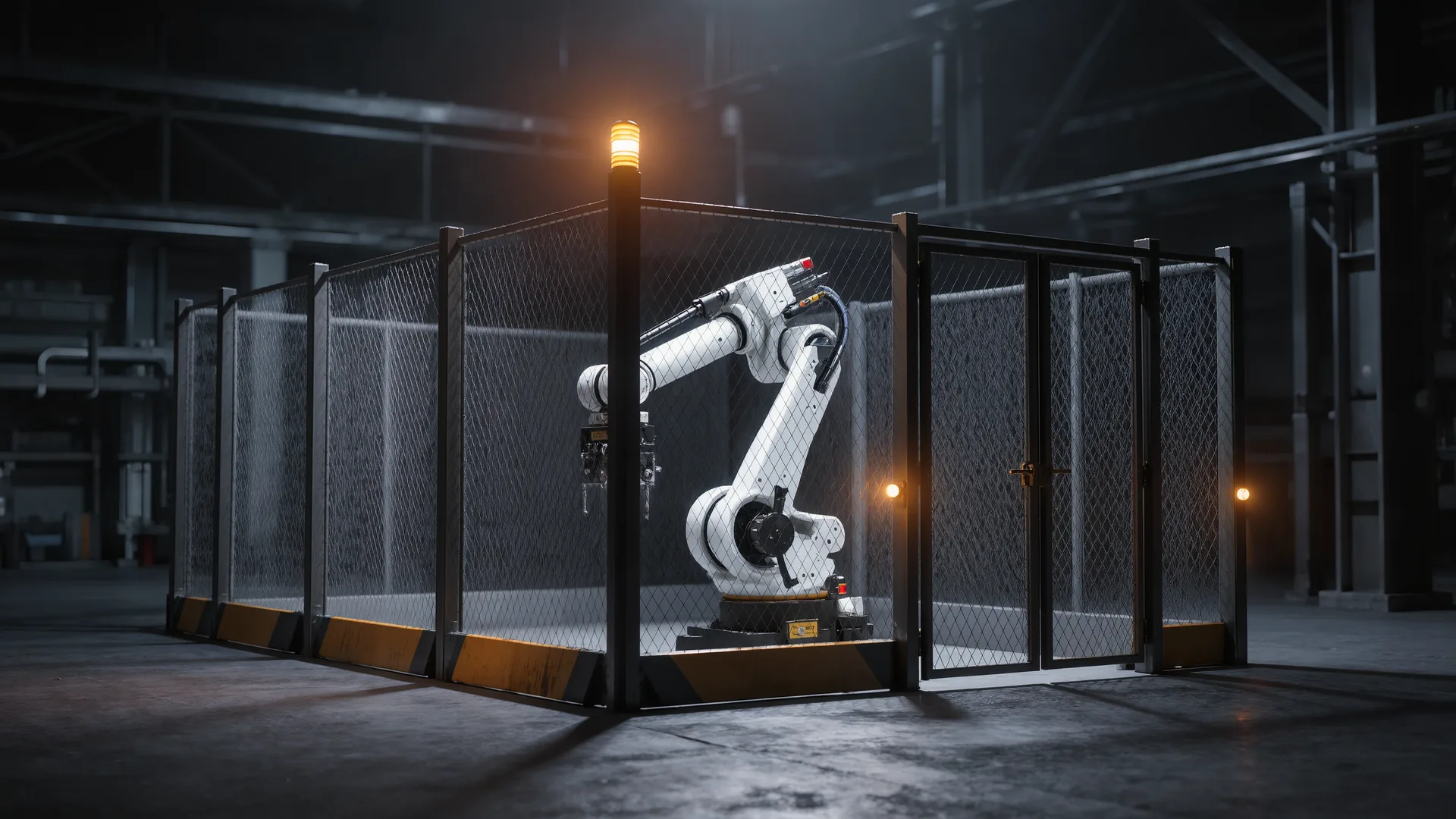
The 250 mm/s limit applies to the tool centre point in manual reduced speed mode, the condition in which a person is inside the safeguarded space with the robot moving. It is a value chosen so a person has time to react and withdraw, and it is a limit on the point of interest, not on joint speed. It does not govern collaborative operation, which is a different calculation entirely.
What it actually constrains
Manual reduced speed mode is the teaching condition: a person is inside the safeguarded space, holding an enabling device, and the robot is under manual control. Three requirements apply together, and all three are safety functions with a derived performance level.
- Speed limitation. The tool centre point, and any point on the robot or its tooling that could contact a person, is limited to 250 mm/s.
- Enabling device. A three-position control that permits motion only in the middle position. Releasing or squeezing it stops the robot.
- Mode selection. A mode selector that cannot be changed casually, since leaving manual mode while a person is inside removes the protection.
What it does not apply to
| Situation | Applies | What governs instead |
|---|---|---|
| Manual mode, person inside, teaching | Yes | This limit |
| Automatic mode behind a fence | No | Full programmed speed |
| Collaborative contact-permitted operation | No | Contact model, typically 400 to 2,900 mm/s |
| Speed and separation monitoring | No | Protective separation distance calculation |
| Safety-rated monitored stop | No | Robot is stationary |
| Mobile robot travel | No | Stopping distance within the detection field |
The third row is the frequent error. Practitioners occasionally cap a collaborative cell at 250 mm/s believing it to be the collaborative limit. It is unnecessarily slow in most cases, because the contact model often permits considerably more, and it is not sufficient in others, because a heavy arm approaching a chest may be limited to 400 mm/s only when the exposed region and effective mass are favourable.
Why a number rather than a calculation
The manual mode limit predates the contact modelling that underpins collaborative operation. It is a conservative fixed value intended to give a person time to perceive unexpected motion and move away, in a situation where they are deliberately close to the machine and concentrating on a pendant rather than on the arm.
It is worth understanding what a person can actually do in that time. At 250 mm/s an arm covers 250 mm in one second, and typical human reaction time to an unexpected visual event is 200 ms to 400 ms, during which the tool travels 50 mm to 100 mm. That margin is the entire justification for the figure.
Practical points
- Verify it is safety-rated. A speed limit implemented only in the application program is not a safety function. Modern controllers provide safe speed monitoring; older ones may not.
- Check the tool. Long tools multiply joint motion into tool motion, and the limit applies to the tool.
- Test it. Measure the actual tool speed in manual mode rather than trusting a menu setting, especially after a controller update.
- Do not rely on it for anything else. Reduced speed is protection for teaching, and it is not a substitute for guarding during production.
- Watch the mode switch. Automatic mode with a person inside the safeguarded space is the condition the whole arrangement exists to prevent.
Frequently asked questions
Why is robot manual mode limited to 250 mm/s?
Because a person is inside the safeguarded space while the robot moves. The value is a conservative figure giving time to perceive unexpected motion and withdraw, and it applies to the tool centre point and any contactable point.
Does the limit apply to collaborative robots?
Not in collaborative operation. There the permissible speed comes from the contact model and body region, typically 400 mm/s to 2,900 mm/s. The 250 mm/s figure applies to manual reduced speed mode on any industrial robot, collaborative or not.
Is it measured at the joint or the tool?
At the tool centre point, and at any other point on the robot or tooling that could contact a person. A long end effector amplifies joint motion, so the joint must run slower than the figure implies.
Can I set the limit in the program?
Not as a safety measure. A program-level speed setting is not a safety function. Safe speed monitoring must be implemented as a rated function with a derived performance level and verified behaviour under fault.
What else must be true in manual mode?
A three-position enabling device permitting motion only in its middle position, and a mode selector that cannot be changed casually. Speed limitation alone is not sufficient protection for teaching.
Sources
- ISO 10218-1:2025, Robotics, Safety requirements, Part 1International Organization for Standardization, reduced speed control and enabling devices
- ISO/TS 15066:2016, Annex ACollaborative speed limits, which are a separate calculation
- ISO 13849-1, safety-related parts of control systemsInternational Organization for Standardization, requirements for safe speed monitoring functions